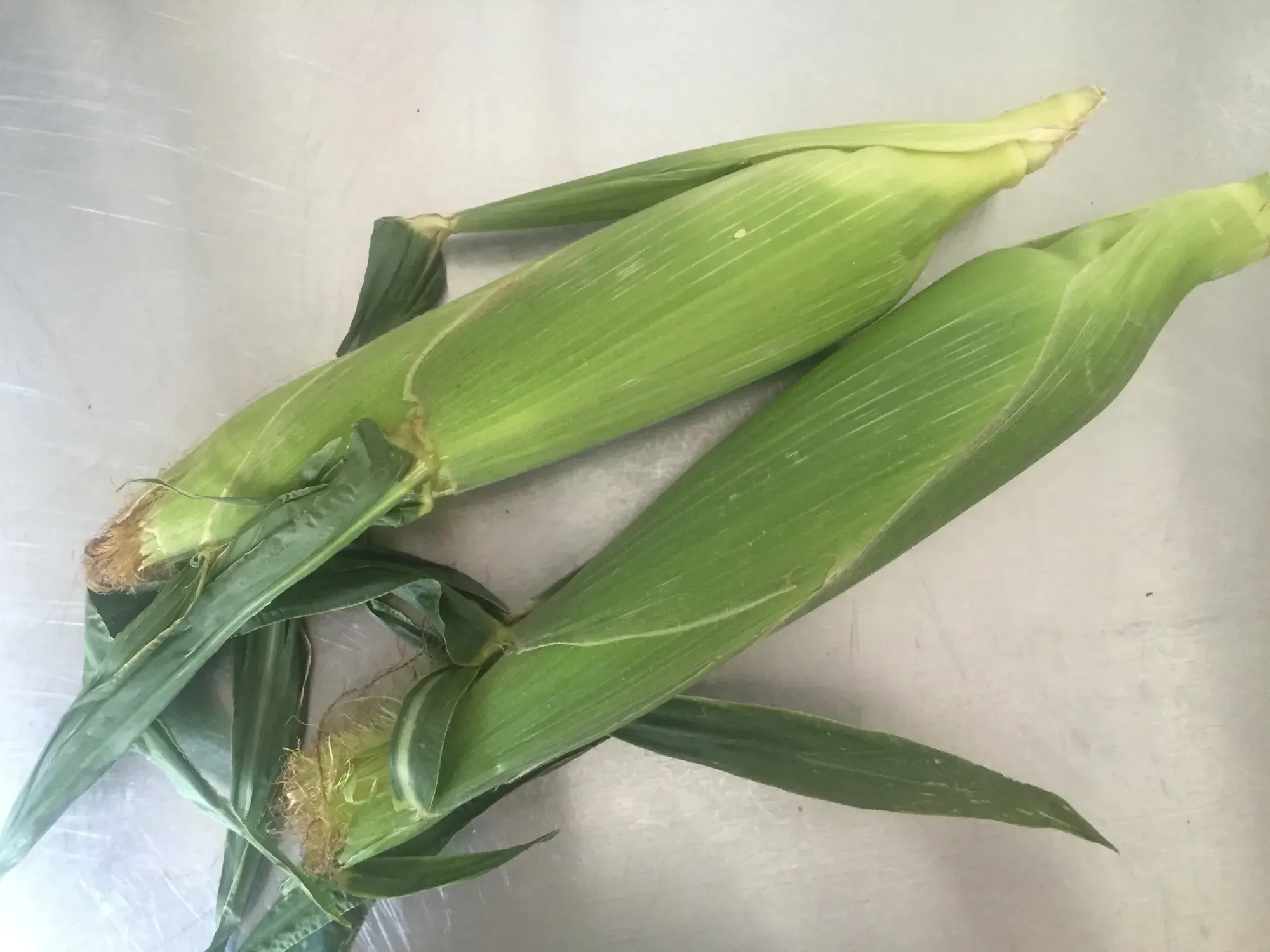
The corn chronicles
We’re growing corn.
I’ve had a summer vegetable garden for fifteen years, but I’ve never grown corn. Cooler urban heads always prevailed. People told me it took up too much room, that it was too temperamental, that it was meant for the hot, humid Midwest flatlands, not Santa Monica’s sandy coastal soil.
So every year I planted the right stuff: tomatoes, basil, eggplant, the ubiquitous zucchini, a green bean or two. But I wondered about that elusive corn. I yearned for it. I kept remembering a story Calvin Trillin wrote about his boyhood in corn country. Trillin was the runner in his family, the one entrusted with picking the ripe corn and sprinting with it into the kitchen, where a pot of boiling water waited. Everything is supposed to taste better just-picked, and corn is supposed to taste best. Precious seconds make all the difference between a reverential experience and a pedestrian one.
Adults tend to believe in limits, though, so every year I settled for tomatoes right off the vine. Then this year, my five-year-old-daughter (who already has a prized set of junior garden tools, and clearly inherited my DNA on the corn issue) announced, out of nowhere, “Let’s plant corn.”
That was all it took.
We ordered “Early Sunglow” sweet corn seeds from Shepherd’s Garden Seeds in Felton, bought white corn from our local nursery and got ready for new heights of gustatory ecstasy.
Not so easy, as it turns out. Corn is a demanding crop. My other gardens did quite well on a mix of sporadic attention and Santa Monica’s encouraging climate. Corn seeds were not about to yield their bounty unless we proved ourselves worthy of the reward. The seeds had to be planted in pairs of rows; a lonely stalk, it seems, is an empty stalk. If they sprouted at all, they had to be covered in netting or the local birds would swoop down like Hitchcock’s gulls strafing Tippi Hedren. If the corn survived its adolescence, it would require food. Lots of it. Special, high-nitrogen fertilizer made from bat guano. (Somehow I imagine I never want to meet the scientist who figured out that connection.)
And then we had to pray for sun, lots of it, in a neighborhood where the euphemism “late night and early morning fog” usually means that we get sunlight between 3 and 3:30 every afternoon.
We did it all. We planted and covered and fed and cursed the clouds until they fled. The early weeks were promising. Little sprouts grew quickly into something that resembled corn; two-foot-high plants that sported wide green leaves.
Then, one morning in mid-July, Sarah exercised her new ability to open the backdoor lock, went outside and let out the kind of scream that starts any parent’s adrenalin pumping. I ran outside expecting to see the empty spot where she had been standing when the kidnaper grabbed her. Instead, I found her standing next to the tallest corn plant, pointing at a green, pebbly topknot that had magically appeared overnight.
“What is it?” Sarah said. “Is that the corn?”
“Well, uh, sure,” I said. “Or maybe not.”
This was the second lesson of corn: Corn is a mysterious crop. The topknot got taller and then opened up into a whirligig of green, pebbly stems. Clearly this wasn’t the corn. If each one of those stems grew into an ear of corn the weight would send the plant crashing to the ground.
We waited some more--and then we got our first glimpse of a silky tassel, growing at the intersection of the trunk and one of the long leaves. Now I was on familiar supermarket turf. That, I announced, was the top of an ear of corn.
We were delirious. We had 16 plants. If each one yielded six ears of corn, a number we settled on arbitrarily (it sounded bountiful), we would get 96 ears. Enough for a corn feast--for several corn feasts. But a friend who lived half a block from the ocean burst that bubble rather quickly. He swore that corn was literal. One plant, one ear.
One ear per stalk? The only corn I have ever seen up close was in the field Gordon MacRae cantered past in “Oklahoma,” and for all I know the prop master added fake ears to make the morning look sufficiently beautiful. I was devastated. I confessed my dismay to Sarah’s summer school teacher, who was about to have the kids plant corn and seemed to know about these things. She regarded me with a mixture of pity and amusement. “He’s got bad soil,” she said. “Sand. And he probably planted in single rows.”
Our fantasy restored, we went back to watching, and waiting. One ear of corn formed, and then another, the husk wrapped in layers around it for protection from bugs or prying amateur farmers. The silks began to darken. By early August we were mesmerized, all of us. Sarah checked the color of the first tassel every morning. My husband, who grew up in Philadelphia apartments and considers a good waiter a primary food source, manned the sprinkler and trolled for snails. I removed aphids with a damp Q-tip, rather than spray our corn with a single chemical.
Even our friends inquired after our progress.
One man, who eats complicated foods and sophisticated wines, confessed that, for all the extravagant dishes he has sampled, he has always longed to taste fresh corn.
A realist asked me what I would do if the kernels didn’t form properly, and for a moment I imagined myself the heroine of an O’Henry short story, sneaking out in the dead of night to paste a healthy ear of supermarket corn on the stalk, to spare Sarah the heartbreak of an inedible ear.
It won’t happen. I believe in this corn. It has marked the passage of a summer--and taught us something about anticipation and patience. There is no meddling with corn. Just waiting, devotion and a clean faith. It is a very romantic food.
I have begun to clear the route from the tallest plant to the cooktop. I have promised Sarah that if the first ear is out of her reach her father will lift her to it and then--very fast--put her down so she can run. I have more than once opened the cabinet to look at the steamer pot I’m going to use.
Last week Sarah and her best friend and I were walking from the friend’s house to ours when Sarah broke into a run. The other little girl yelled at her to wait, but she kept running--and for once I forgot my job as peacemaker, mediator, traffic cop--and just watched her go. She’s fast. She pumps her arms; she’s got a nice, straight, tough little stride. Let her go. I can see it already: She’ll be in the house, an ear in each fist, in nothing flat.
More Articles
Restaurant baby
Recipe for a happy childhood: Bottomless Shirley Temples while my dad sold stockpots.

A good man is easy to find — and hard to date.
Men prefer younger women. Women over 60, you know I’m right.

Am I too old to get a dog?
To get a dog or not to get a dog, that is the question.

Freebie food: Why we can’t trust restaurant influencers
Tell me if you've heard this one: An influencer walks into a bar. . . . No, wait. It's no joke.
Second Helpings
Subscribe for updates, articles, and commentary directly to your inbox.