Articles
Restaurants, tech millionaires, longtime residents and encampments: Who runs Rose Avenue?
Caught between new tech money and a growing homelessness crisis, restaurants on one street in Venice, California, are trying to keep its identity alive.
[Source] The Counter
Society for Advancing Business Editing and Writing Award: General Excellence, Industry/topic-specific publications
Jason Neroni lives on Rose Avenue, though his house is 10 minutes away. The chef and managing partner at The Rose Venice, a bustling 375-seat restaurant two blocks from the Pacific Ocean in Los Angeles, spends more waking hours there than he does at home with his wife and two children: weekends, late nights, holidays, usually from 11 in the morning to 11 at night. When he isn’t at the restaurant, he is as close as a text or a call.
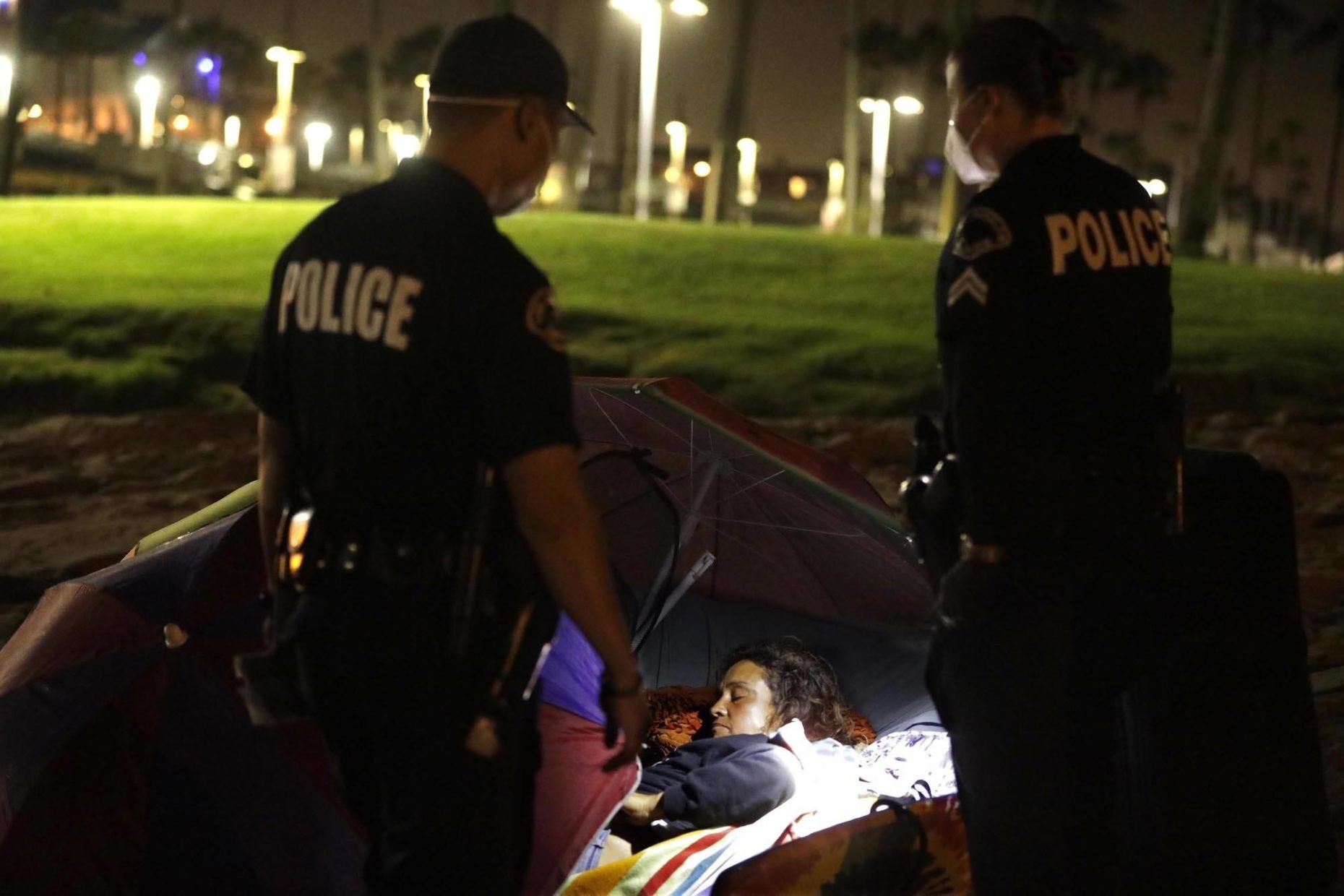
Linda lives across the street from him, but again, not in the way you might think. Her home is in plain view from a table on the Rose’s front patio, and most days she’s outside, tidying up—sweeping the sidewalk in front of her two tents, sorting through the large bag that stands in for a kitchen pantry when ants invade her food supply one morning, her graying hair tucked under a scarf. She feels safer here than in the apartment she left six months earlier, though not safe enough to tell me her last name, which is why I have changed her first. People, she said, are looking to do her harm.
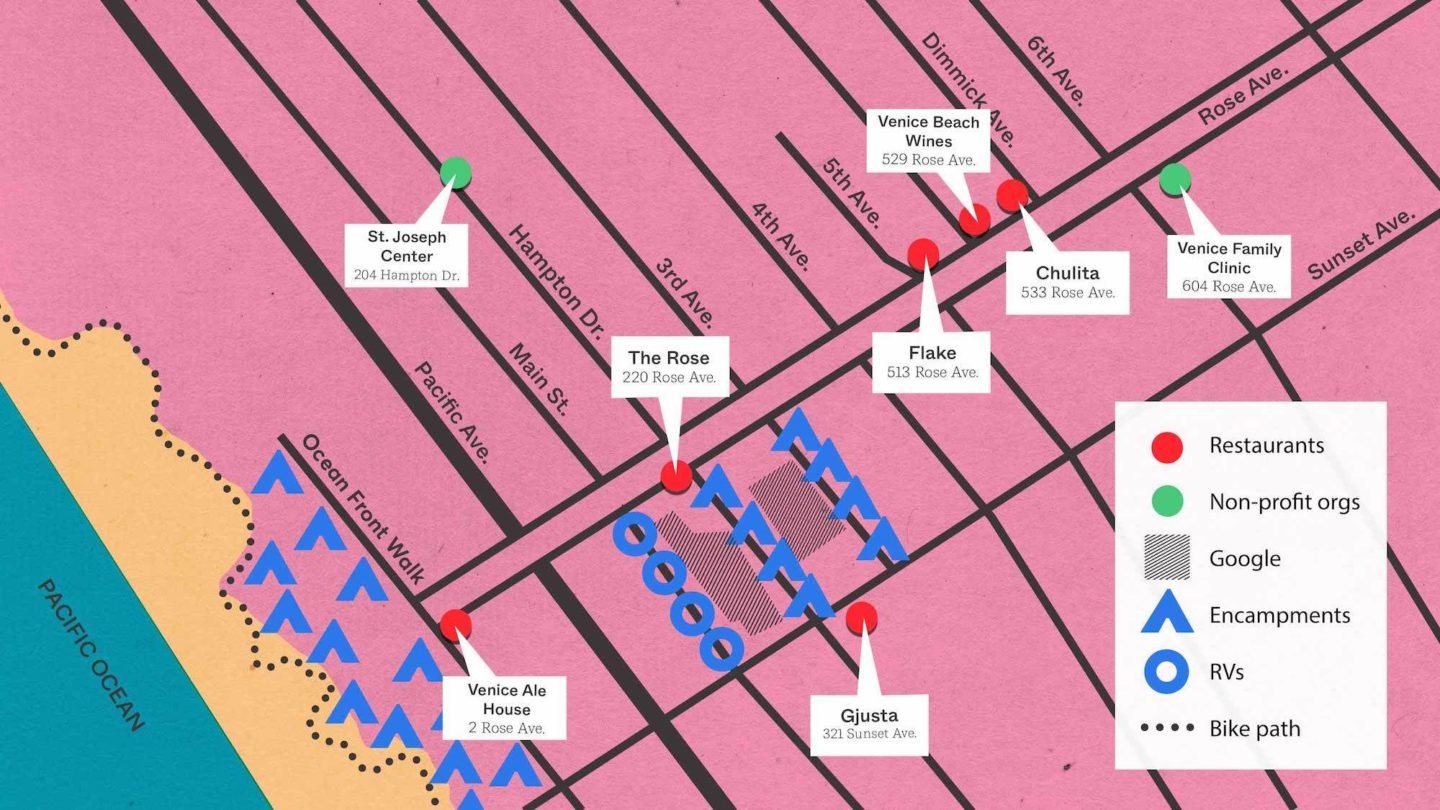
Their other neighbor is Google, whose 100,000-square-foot campus wraps the Rose in a lopsided, understated embrace; there is no big identifying sign on the buildings, but the guards pedaling around the immediate neighborhood wear windbreakers that read “Google Security” on the back. The buildings were full of Google employees until the pandemic emptied them out, and will be, again, but the sidewalks belong to people who live in encampments, like Linda.
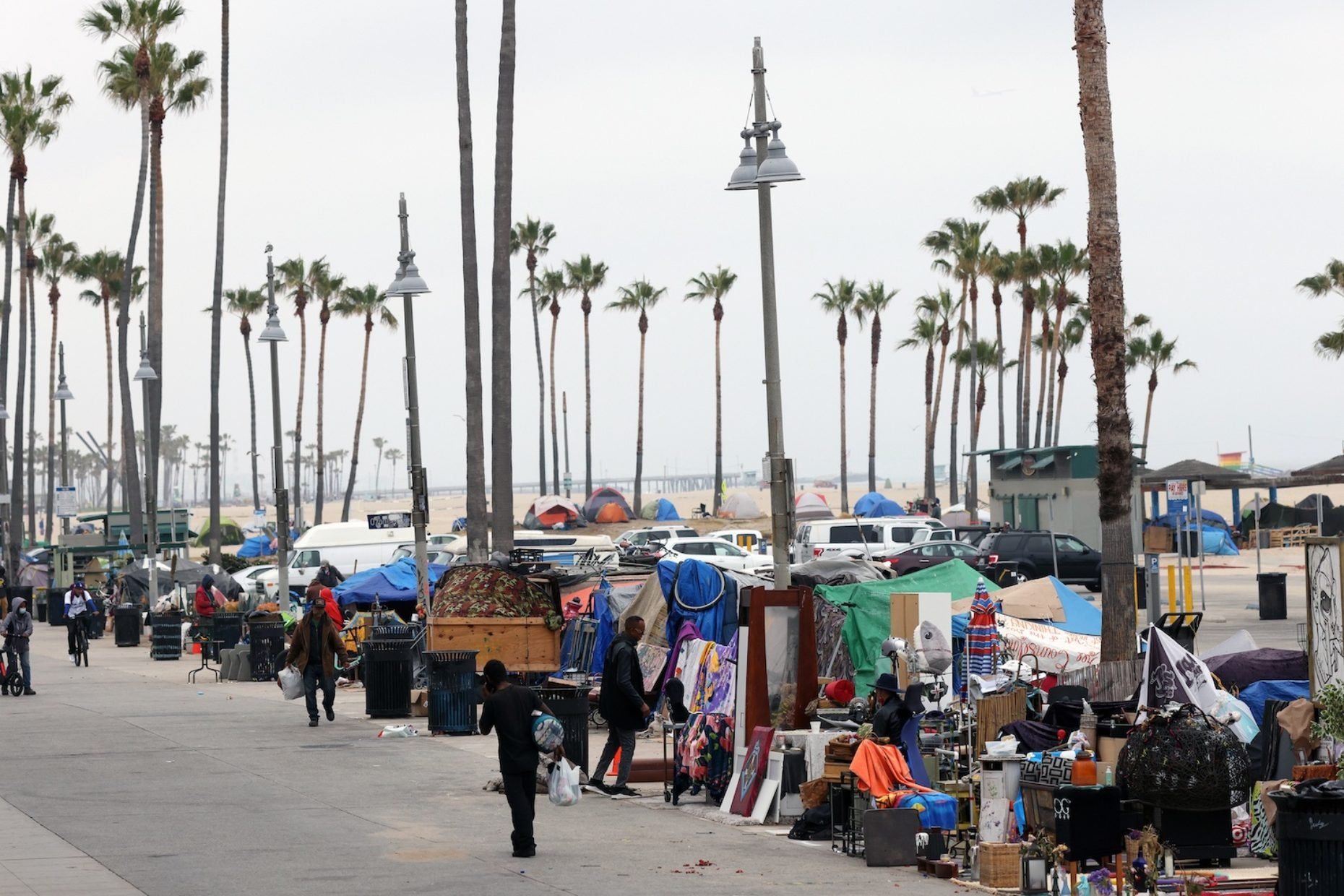
Linda lived at Rose Avenue and Hampton Drive at the start of the summer, right in front of Google, at the northernmost end of a block-long encampment that spilled into the Gold’s Gym parking lot at the other end. Hampton, in turn, was part of a larger grid that framed Rose Avenue from Ocean Front Walk, the popular beachfront boardwalk, east to Lincoln Boulevard, where the almost mile-long business district ends. Over 200 tents lined the edge of the sand along the bike path, and still more people lived on the boardwalk itself, on benches, in cupolas, and along the low wall that separates the boardwalk from beach parking. Two rows of permanently parked campers and motorhomes occupied Main Street, two blocks inland, and Linda’s street came next, with a larger encampment one block up, on Third Avenue. Another row of vehicles going nowhere sat on Rose at Lincoln, next to the Whole Foods parking lot. There were an estimated 1,900 unhoused people living in Venice, and Rose Avenue was the nexus of that community.
People experiencing homelessness have settled in Venice for decades, in part because nobody was going to roust them, which was part of the neighborhood ethos.
I live four blocks from Rose Avenue. Since last May, when I started to work on this story, I’ve bicycled up and down Rose and the surrounding blocks, to see how the street behaved, and who came and went. I’ve lived within a half-mile of here for most of my adult life; I’ve marked time for many years by what happens on Rose Avenue.
The current scene is nothing new and utterly different. Independent restaurants have staked out Rose Avenue as their home, and have been part of the community in the way that a franchise outlet or chain cannot, essential to the street’s personality. Longtime local residents were drawn to the neighborhood for the same reason—for the non-franchise experience—and were loyal to the restaurants that shared their point of view. Over time, a community grew up around places that felt like incarnations of the street’s soul. A pervasive live-and-let-live attitude verged on an imperative, as residents and businesses who wanted a broader range of experience accepted the fact that it might not all be easy fun. People experiencing homelessness have settled in Venice for decades, in part because nobody was going to roust them, which was part of the neighborhood ethos. Life went on, and part of it happened in restaurants, where regulars bumped into other regulars, and an unhoused person might pick up a job or a free meal.
It’s not like that anymore. Restaurateurs were on thin ice even before the pandemic, and the smart ones proceeded cautiously. Many didn’t have the time to grab a cheap lease on an empty block and wait for it to catch up, but they also couldn’t afford a more established, high-traffic location. They looked instead for the middle ground, a street with enough potential customers to make economic sense, but not so settled as to be out of their fiscal league. They looked for someplace like Rose Avenue.
Restaurants that had been on Rose for years, and survived the pandemic on fumes, had a right to be there, too.
It worked well enough until it didn’t, until the pandemic exaggerated every challenge the street had always faced, making everyone more vulnerable—the restaurants that gave Rose its public personality and were suddenly hanging by a thread, and the residents who lived there, whether in a standing residence or a portable one.
Neroni was more unnerved than someone with a smoother past might have been, because he had come close to the edge, himself: Ten years earlier he’d been in New York City when the funding for a new restaurant dried up, without warning, and suddenly he was an unemployed chef.
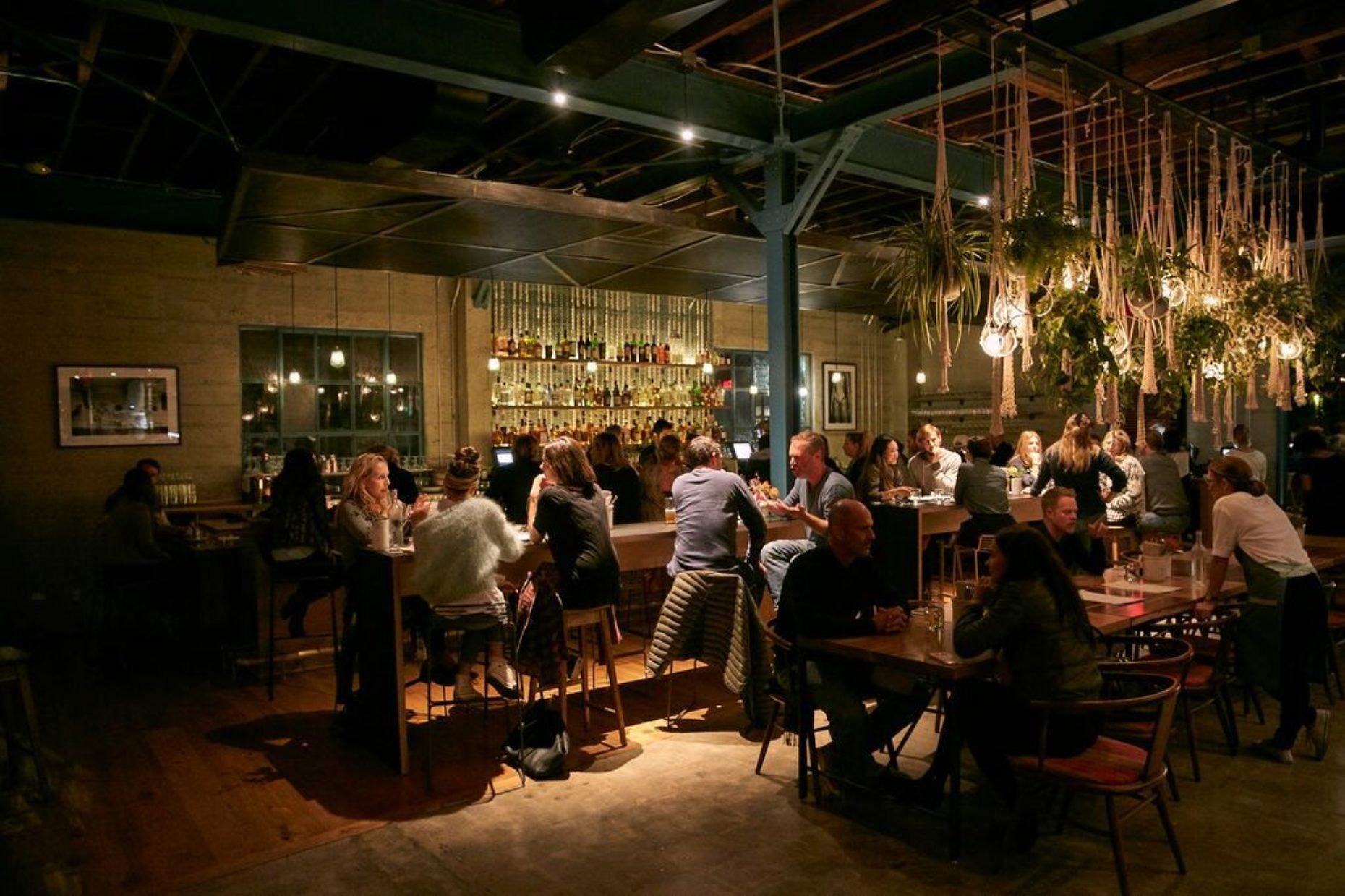
Expenses don’t wait for luck to change. Neroni envisioned his young family living in their car if he didn’t figure things out fast, until his grandparents in Garden Grove, California, made a high-stakes offer of temporary housing: All Neroni had to do was give up his New York dream, move his family in with them, and start over, at 35. By 2015 his life was back on track. He and a business partner took over the Rose, which in a single pre-pandemic year racked up 2 million covers, or individual checks, thanks to a heady combination of locals, the tech crowd looking for a clubhouse, and tourists.
No longer.

Venice, a beachfront community annexed by Los Angeles in 1926, is the second most popular tourist destination in Southern California, after Disneyland, according to the city’s Parks Department, and Rose Avenue is its Main Street, promising food, shopping, and a late-day, sunset stroll that never gets stale. People who chase experience come to Rose Avenue, which has long resisted big-name corporate incursions, and congratulate themselves for appreciating its creative soul. People who want something more familiar go elsewhere. If there is an element of danger to it—and there always has been—Venetians do their best to skirt it, even to pride themselves for not getting rattled. Rose Avenue is authentic take-it-or-leave-it Venice, not a destination designed to cosset anyone.
Unhoused people have long gravitated to Venice, which has provided support services even as it enforced city practices that limited the ways in which people lived outside, but the pandemic changed everything. The hot-shower truck was unreliable, portable toilets were cleaned less often, and new portable wash stations became de facto trash receptacles.
There was a moratorium on weekly street cleanings and city ordinances that had required people to live in portable homes they could move when the sanitation workers and police arrived. Without that codified disruption, many people abandoned individual tents in favor of what locals referred to as “super-structures,” abodes constructed of tarps, tents, scavenged drywall, whatever it took to build out a home that spanned sidewalk to curb and gave people more space. Pedestrians had no choice but to walk down the middle of the street on Hampton Drive and Third Avenue. Both residents and restaurant people speculated on whether the dismantled bikes they saw were stolen and rebuilt to avoid easy identification, and assumed that the drug sales they used to see in plain view now transpired inside some of these structures. They shared rumored talk of prostitution and gangs. But the police were precluded from entering a tent without a warrant, by the same Fourth Amendment that protects residents of permanent housing.
The neighborhood had become a combustible mix of too much need and too few resources. Neroni began to keep an informal log of troubling incidents—security camera footage of arguments among people from the encampments, day and night, that spilled into the street or the Rose’s parking lot—and when he reached out to his restaurant neighbors on the street, he heard his own experience echoed back. As calls for help went unanswered, each restaurateur or manager or employee was left to figure out how to protect their co-workers and their customers. Neroni hired a private security firm and reimbursed employees out of pocket to replace their cars’ broken side-view mirrors.
He wished the city would do more to provide even temporary housing for his neighbors, but other than a hardly sufficient 30-unit building going up across from Whole Foods, he pinned his practical hopes on the return of city services. Not that he had any idea how it would work: When he stood outside and looked the length of Hampton Drive, he saw structures that were simply too big and cumbersome to move. It was a crisis in the making, after years of simmering conflict between the community on the sidewalk and local businesses and residents, because the city’s old methods of addressing the situation simply wouldn’t work anymore. Sanitation crews and the Los Angeles Police Department (LAPD) could tell people they had to move, but residents of these larger structures couldn’t comply without losing much of what they owned. Still, something had to happen, and soon. Restaurants that had been on Rose for years, and survived the pandemic on fumes, had a right to be there, too.
The street teetered now, off balance: People who work on Rose hope for some kind of intervention, while people who live on the street hope to be left alone.
On one Saturday night in May, the Rose’s private security guard defused an incident after a handful of calls to 911 went unanswered, and Neroni reached his breaking point. Venice’s reputation as an edgy, idiosyncratic place—“Bohemian” was the default adjective—was seductive only as long as it didn’t feel threatening, and Rose Avenue was starting to feel out of control even to the people once drawn to its unpredictability.
The security guard checked LAPD’s scanner and told Neroni that he could hear the calls coming in, but no one had responded.
“They’re never coming,” he remembered the guard telling him. “You’re on your own.”
Venice has inequity in its DNA: Developer Abbott Kinney, a chain-smoking asthmatic who made his fortune in tobacco and fell in love with Italy’s Venice, wanted to recreate it as a tourist mecca in Los Angeles. Venice of America, as he called it in 1905, offered visitors a replica of Venetian canals and buildings with Italianate arches, as well as piers, a roller rink, a dance hall—even an indoor heated salt-water pool, much of it built and staffed by Black employees who were installed in a square-mile neighborhood on the inland side of the electric car tracks and were prohibited from living closer to the beach. The resort, its white guests, and wealthy weekenders occupied the space west to the water.
It was an invention, that early Venice, and like any fiction was a mix of truth, lies, fantasy, and myth. As the story goes, a single surviving grid of canals—the others were filled and paved over starting in the late 1920s by a city in love with the automobile—exists only because a contractor was paid in advance, took the money and ran, and the city decided not to spend it twice.
If the rest of the canals are gone, the economic extremes that created them are not. A man wealthy enough to create his own version of a beloved city—and to employ people who were dependent on their wages—had left Venice a gambler’s legacy, an affection for the unlikely idea. There’s more existential elbow room in Venice compared to coastal neighborhoods that developed along more traditional lines, more acceptance of someone who has a dream rather than a career path. But fewer limits can work both ways, a meteoric success or a crash and burn. The landing, if things don’t work out, can be a hard one.
There has been plenty of bad luck to tip the odds: In the 1970s, cutbacks on affordable and subsidized housing; in the 1980s, a broken promise of local mental health facilities that put people on the street without essential support services; a nationwide population boom in the 1990s that brought 4.1 million more people to California and turned Los Angeles’ already insufficient housing supply into a harsh game of musical chairs; the 2008 recession, which pried open the grasp of people barely clinging to stability. The only constant was the eternal lure of land near the beach, which attracted people who could afford outsized prices and made matters worse for everyone else.
The arrival of Google and Snapchat, in 2011 and 2012, respectively, brought the latest infusion of buyers’ money, as a new, young, wealthy crowd looked for places to live near the office. Snapchat decamped in 2017, but not before tech employees drove real estate prices even higher, tightening the rental market.

As early as 2013, a local realtor described Venice prices as “through the roof,” thanks not only to the two tech behemoths but also the smaller start-ups and tech incubators that trailed in their wake. Realtors have a code to describe the area’s appeal: “AWOL,” which means Always West of Lincoln. You can’t go wrong buying property there, even if $1 million is barely enough for a teardown.
Restaurants reflect and define their neighborhood, and for years the places on Rose had offered diners a good time that was unique to the street, at restaurants and shops they couldn’t find anywhere else. But the pendulum swung both ways, and an influx of discretionary income threatened to disrupt the street as much as Neroni’s growing list of incidents. Restaurateurs kept a wary eye on nearby Abbott Kinney Boulevard, dubbed “The coolest street in America” in 2012 by GQ magazine, which had resembled Rose Avenue until national and international brands started to shoulder independent businesses out of the way. Vestiges of the old street remained, the occasional local clothing shop or bar, but they were the exception that proved the rule. Abbott Kinney felt like a hipster Venetian version of Beverly Hills’ Rodeo Drive, which was not at all how Rose Avenue saw itself—and yet on a bustling Saturday night, when the new crowd hit both streets, it could be hard to tell the difference.
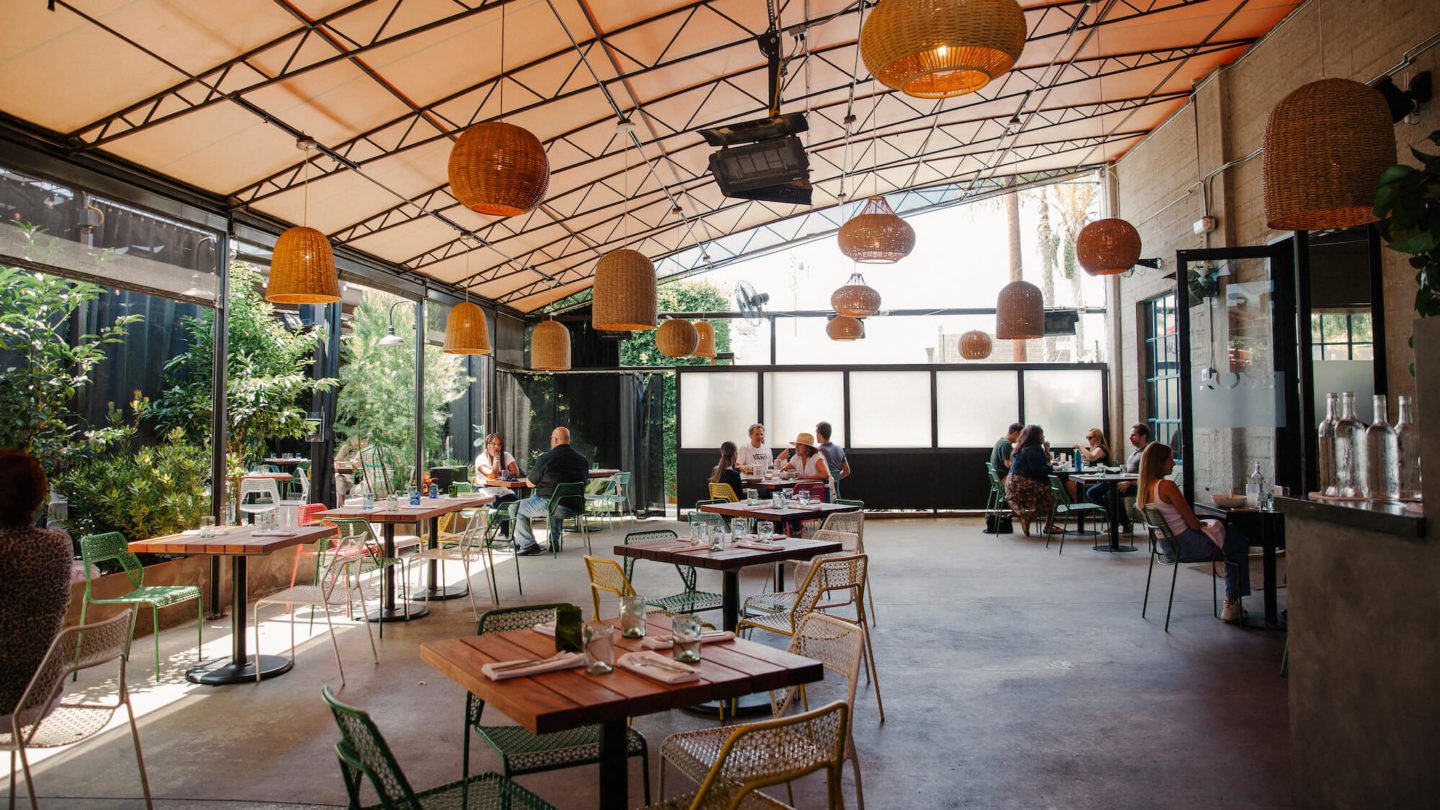
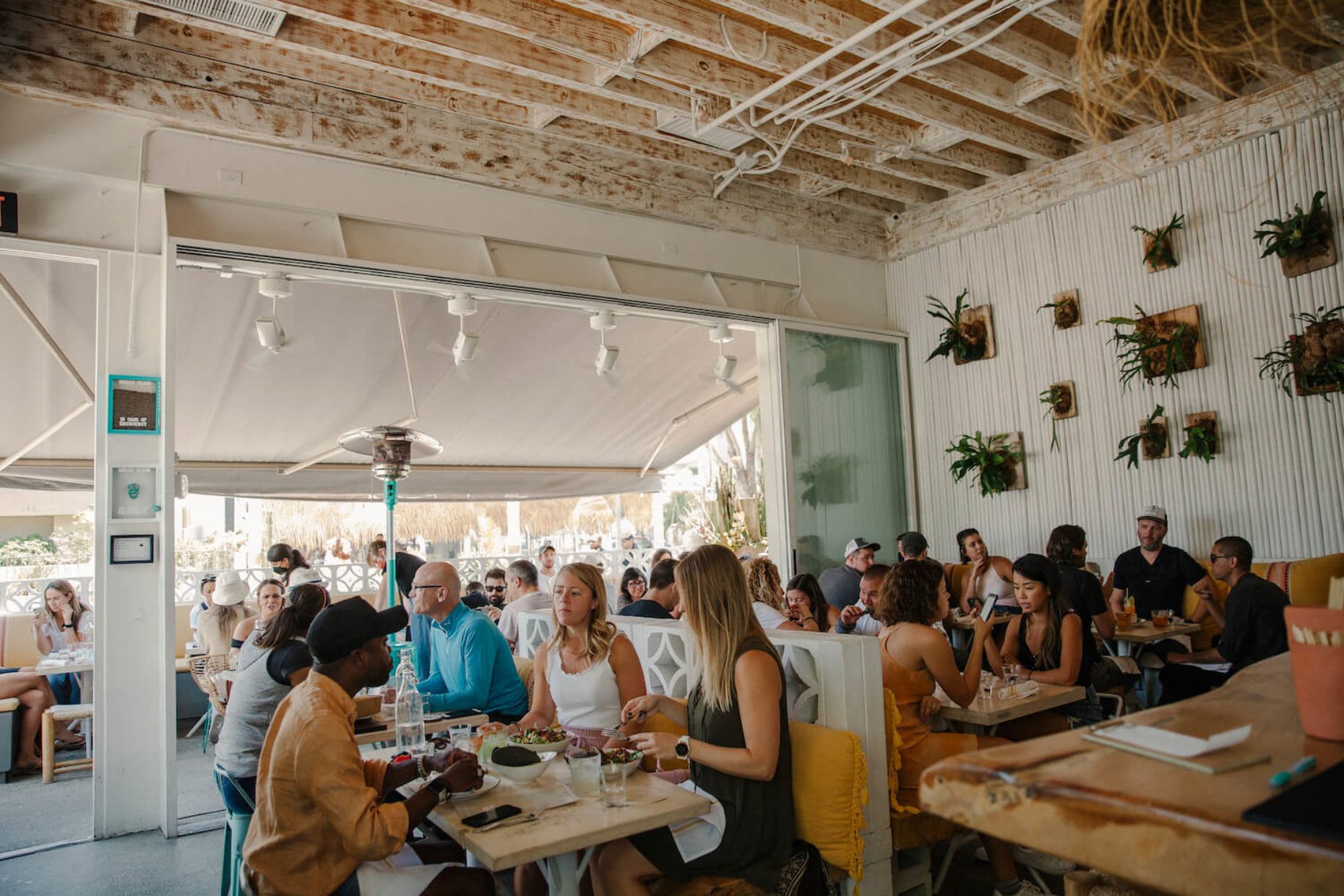
No place symbolized the tension more than the 42-year-old Rose Venice. It had unofficial landmark status, the avenue’s namesake, a big, bustling gateway to the Rose Avenue experience. On the other hand, you had to have money to eat there, and either enough audacity to think it was your right to do so, or enough history in the neighborhood to want to linger at a beloved, familiar spot.
The pandemic shutdown had turned Rose Avenue into a temporary ghost town, then a take-out corridor, and now, finally, a row of struggling businesses hoping to regain their feet during the summer season, always their busiest.
The street teetered now, off balance: People who work on Rose hope for some kind of intervention, while people who live on the street hope to be left alone. LAPD senior lead officer Adrian Acosta has worked in Venice on and off for 16 years, at one point as part of the gang unit that patrolled the area where Abbott Kinney’s employees once lived, so he’s seen more than one type of conflict during his tenure. His responsibilities now include Rose Avenue from Hampton Drive to Lincoln, and his appraisal is absolute: The vibe there has changed for the worse.
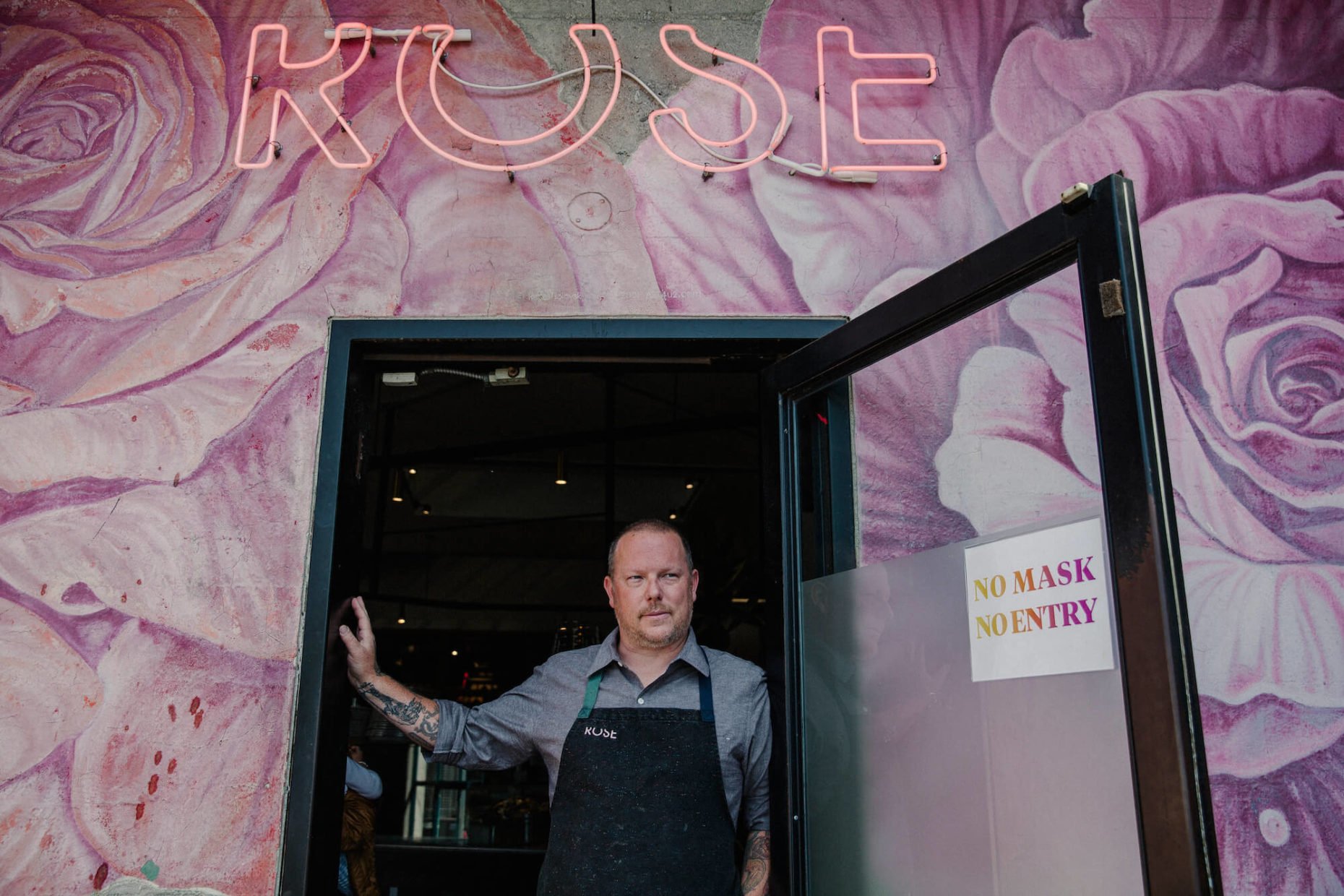
Neroni lost his patience, that Saturday night in May, because of a 6-foot guy waving an aluminum bat. The man first appeared at the corner, yelling at people and cars and waving his arms, just feet from where customers checked in at the Rose’s outdoor host stand. Neroni’s managers called 911, but by the time the chef got to the front door the man had disappeared.
When he returned moments later with the bat, the chef told his managers to call 911 again, as well as the private security service. He started to step forward, and stopped. “He swings that bat right,” thought Neroni, “and I’m paralyzed.” To his relief, the armed security guard showed up, and his official-looking uniform was enough to discourage the man with the bat, who dropped it and wandered off down Hampton Drive. The police didn’t respond to the second set of calls, either, which was when the guard explained that they never would.
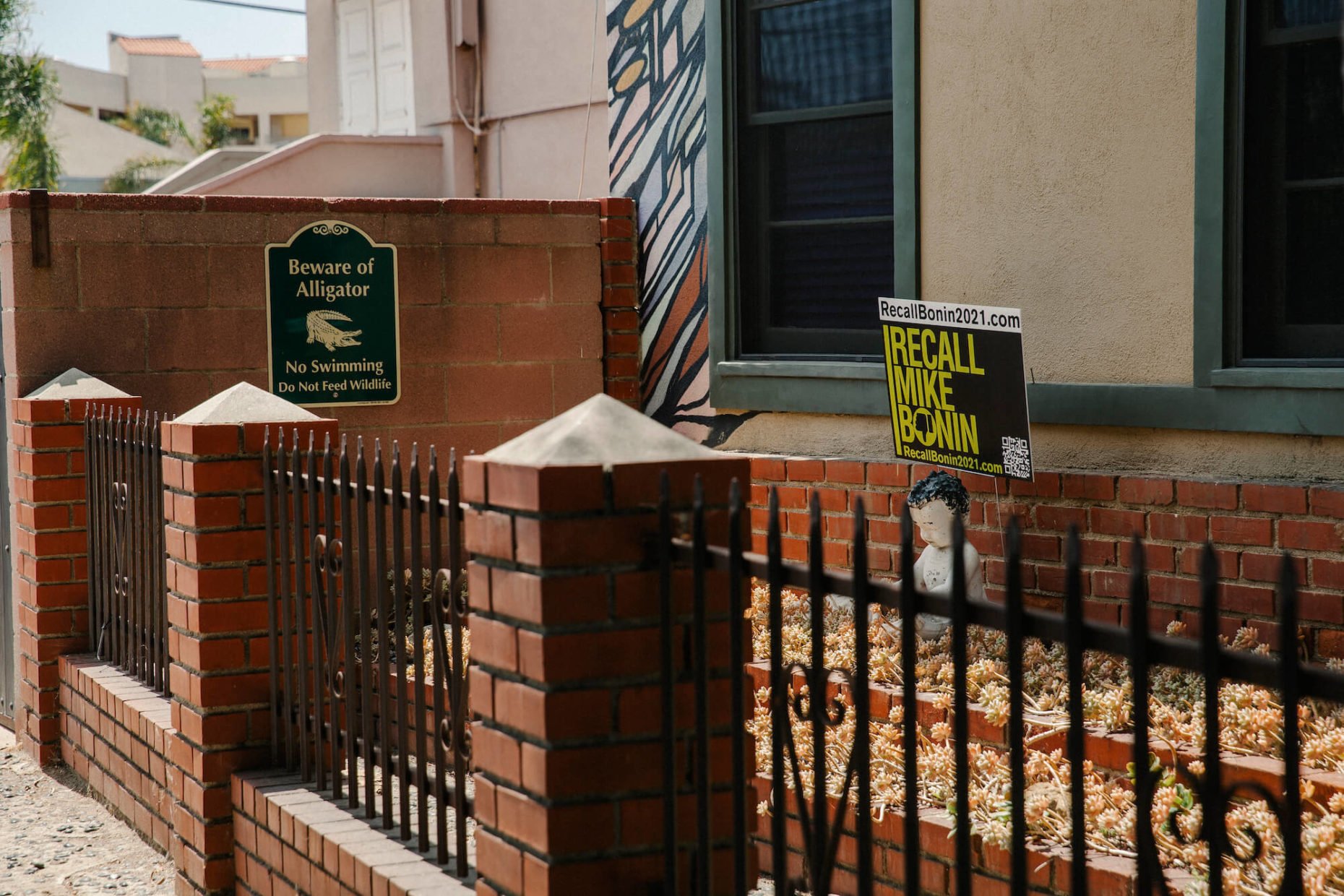
Neroni was tired of feeling ignored, tired of feeling like the street’s problems were the street’s to solve. He sent an email to his city councilman, Mike Bonin, a strong advocate for the rights of the unhoused and a target of increasing ire from an impatient wing of local residents and business owners who wanted action.
“I am writing to personally invite you to the Rose to sit down and have a cup of coffee with me,” he wrote. “I would love the opportunity. . . to show you my home (The Rose), meet some of my family (our staff), and share with you our experience over the past year.”
The pandemic shutdown had turned Rose Avenue into a temporary ghost town, then a take-out corridor, and now, finally, a row of struggling businesses hoping to regain their feet during the summer season, always their busiest. Neroni intended to pursue his councilman until he and his restaurant neighbors got the attention he thought they deserved.

But the councilman and the county sheriff, Alex Villanueva, were entangled in a turf war, sparring over who had jurisdiction over the beachfront boardwalk encampments and what approach to take, with Bonin talking about compassion and patience, and Villanueva talking about lawbreakers and the need to give public land back to the public.
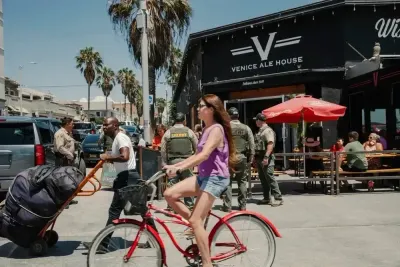
The sheriff staked his claim first, appearing on June 9 in front of Venice Ale House, where Rose dead-ended into the Ocean Front Walk, to announce that the area would be clean by the July Fourth weekend, that living on the street was illegal, and that arrests were not out of the question. The next day Councilman Bonin announced the $5 million Encampment to Home program, which would provide immediate funds to secure temporary homes for Venice’s unhoused population. He, too, would oversee a boardwalk clean-up, but without arrests.
Five days later, on June 15, Bonin was served with a recall notice, the second time constituents had attempted to remove him from office.
Venice Ale House owner Thomas Elliott has lived six blocks from the corner of Rose and the boardwalk since 1997. He was here for the boardwalk’s heyday, the “party era” when marijuana and alcohol were the drugs of choice, and the people who lived on the boardwalk and at the beach were too few in number to form an encampment like the one he saw outside the Ale House at the start of summer.
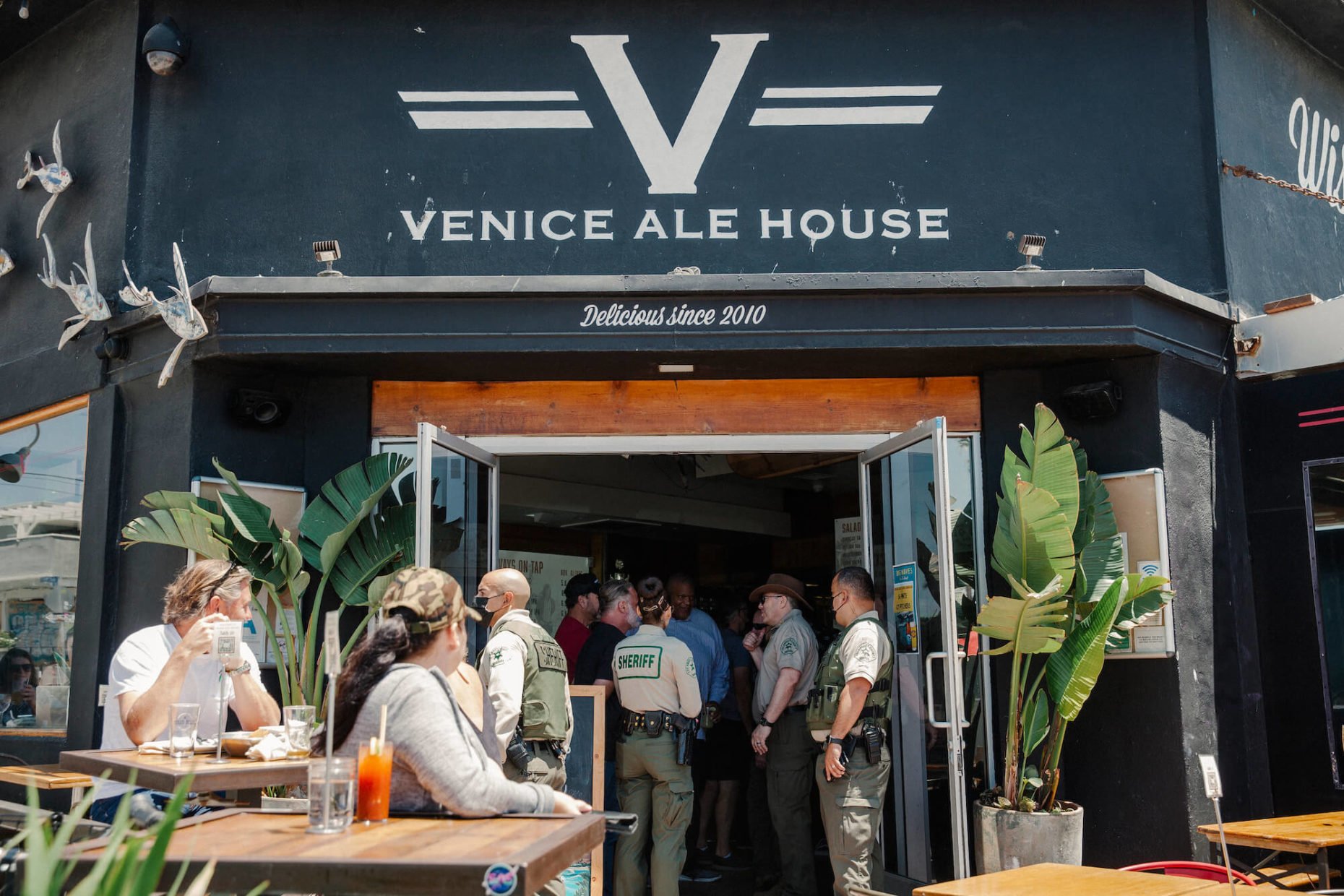
Elliott knows exactly when the current spike began—the night in March 2020, when Los Angeles restaurants shut down for the pandemic—because he watched it begin, from home, on the restaurant’s security camera footage. “It started raining, and I was so afraid we were going to be broken into,” he said, “so I’m watching the cameras, and I saw this sad, sad guy, all drenched, pull his cardboard and blanket and tarp under our awning, and what am I going to do, roust him? Of course not.”
The next day, Elliott watched as a woman dragged her folding chair under the Ale House’s awning, followed days later by a man in a wheelchair. “They lived there,” he said. “We had an outlet out there so they pulled in their cell phones and built a canopy.” They stayed until the city allowed restaurants to re-open for take-out, two months later, at which point Elliott approached the trio and asked them, “politely,” he stressed, to move.
“There are no boundaries. It’s a humanitarian crisis, no different from any refugee crisis.”

As the encampments across the boardwalk and on the low hill by the bike path continued to grow, Elliott saw a different type of drug user than he’d seen in the 1990s —less mellow, more addled and aggressive, likelier to have turned to methamphetamine and fentanyl, which were cheap and easy to find.
“Every day there’s someone outside panhandling,” he said. “Or a customer comes in to ask, ‘Can I have another sandwich?’ A woman just walked by and grabbed the sandwich off his plate. People walk by and grab drinks off tables. I used to be [able to] police my own restaurant, but I’m not enough. And we’re definitely losing business.”
His security guard had instructions to intervene if anyone breached the invisible perimeter of the outdoor seating in front of and alongside the building. Elliott said it happened almost every evening.
Elliott doesn’t hold his neighbors responsible for what’s going on; he blames the city for what he said is both a housing and a public health crisis. “People do what they’re allowed to do,” he said. “There are no boundaries. It’s a humanitarian crisis,” he said, “no different from any refugee crisis.”
The city beat the county to the boardwalk with a clean-up and rehousing effort that began on June 28 and worked its way north, landing in front of Venice Ale House on the morning of July 13. It was a two-step process: People had to decide what they wanted to carry with them or put into temporary storage, while anything else would be thrown away, and then they were provided with transportation to temporary new homes. The crowd that gathered to facilitate the effort included a city sanitation crew, LAPD officers, and representatives of the nonprofit St. Joseph Center.
Marce de Thouars has worked for the sanitation department since 2013, usually on the city’s downtown Skid Row. He said he has learned two things: People who live on the street regard him as “the enemy,” so it was important to avoid confrontation, and even a peaceful process is no guarantee of lasting success.
“There are different agencies out here trying to help people get back on track,” said de Thouars, “but it’s very hard, because the big majority suffers from addiction, whether it’s alcohol, drugs, you name it. They aren’t bad people. They’re just out of luck.”
Francisco believes Rose Avenue is doomed, not because of the increase in the unhoused population but because of a pervasive corruption that depends on Venice for everything from lucrative real estate deals to nonprofit payrolls.
Helping them was someone else’s responsibility. His job, as he saw it, was to keep public spaces clean, which the boardwalk and the tents across the parking lot were not. The area might not have been pristine before the recent increase in tents, but the sheer number of people now guaranteed an increase in public health issues.
At the center of it all, as de Thouars and his coworkers waited, a white-bearded man sorted through a shopping cart full of his belongings, dividing them into three sets—what he would take with him, what he wanted the city to pack into a storage bin, and what he was willing to consign to the trash. It was a slow process, its logic known only to him. He considered two bottles of water for a long moment before deciding which one to place with his traveling possessions and which one to hand to a sanitation worker.
Nobody rushed him. In fact, people barely spoke. For a good half hour they waited, made small overtures, backed off, and waited some more. The man with the beard was going to sleep somewhere new tonight, and the transition would be on his terms, at his pace.
George Francisco was not impressed by the effort, but then, George Francisco has more than had it. The president of the Venice Chamber of Commerce is the Cassandra of Rose Avenue, certain that his prophecies are true and equally sure that no one wants to hear them. Francisco wouldn’t win any popularity contests in Venice on a good day—an adamantly independent voter in a liberal Democratic enclave, a cynic about bureaucracy whether it’s governmental or nonprofit, a villain in certain quarters simply because he represents the area’s business interests. It gives him a kind of freedom; he uses words like a match to kindling, and is proud of it.
What he has to say is hard to take. Francisco believes Rose Avenue is doomed, not because of the increase in the unhoused population but because of a pervasive corruption that depends on Venice for everything from lucrative real estate deals to nonprofit payrolls. To hear Francisco tell it, corruption in Los Angeles makes corruption in his home city of Chicago seem like small potatoes.
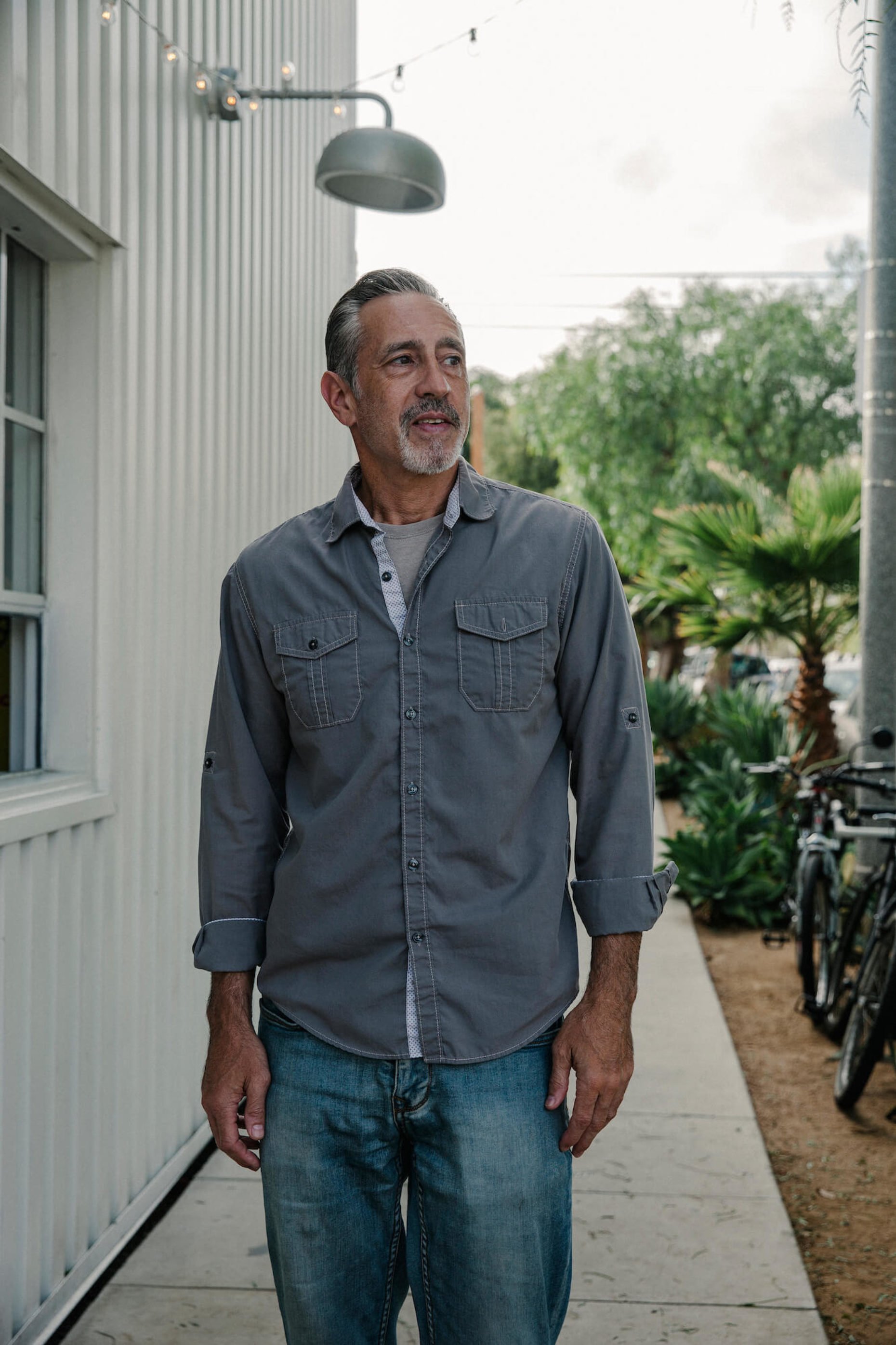
He is not an armchair critic: Francisco has spent six years as president of the Chamber of Commerce, nine years as a member, seven years on the Venice Neighborhood Council, the last five as vice-president, and has participated in programs designed to improve communications between the community and law enforcement. But no one likes to hear that hope is gone, so he’s lost traction, over time—which has hardly shut him up.
He blames the city planners who ignored Venice’s original design and made it difficult to own a business or live there, with prohibitive parking requirements and residential zoning that limited housing, and accuses powerful people of letting their personal agendas eclipse what was best for the area. He blames city council people past and present, city government in general, homeowners with generational wealth who opposed the greater housing density that would get some people off the streets, and what he and others, including the county sheriff, refer to as the “housing-industrial complex,” the large nonprofits whose administrators, to Francisco’s way of thinking, would be out of their six-figure jobs if unhoused people found permanent homes.
He nursed a vision of Venice, and of Rose Avenue, specifically, that was probably extinct, or at least in its death throes, and he hated what was happening—or more to the point, not happening—because it wasn’t supposed to be this way.

Dr. Va Lecia Adams Kellum, president of the St. Joseph Center, had heard the criticisms, not only from Francisco but from the county sheriff, who of late had pinpointed nonprofit salaries as a waste of money. She did not take the bait, because comments like that only betrayed a lack of understanding of what her agency was trying to do.
St. Joseph’s slogan, “Hope Through Empowerment,” conveyed its four-part mission—to provide poor and unhoused populations with the resources they needed to become self-sufficient, through a combination of outreach, housing services, mental health care and educational and vocational programs. The center, founded in 1976 in a small Rose Avenue storefront, was now a citywide service organization whose main site was a large building on a quieter stretch of Hampton Drive. It had been brought in to facilitate the boardwalk cleanup, which Kellum pronounced a resounding success: 213 people were moved off the boardwalk, most of them into temporary housing, because finding apartments for the ones who received subsidies for permanent housing could take another six months. St. Joseph representatives “engaged” with many more people who chose not to accept housing, she said, to let them know about other available medical and mental health services. An impatient critic might see the glass as half empty, because some of the beachfront population was still on the street, and people might circle back to the neighborhood when temporary housing ran out. Dr. Kellum took a longer view: Rehousing simply took longer than local residents—and restaurants—might like.
“We’re okay with being put out of a job if we can address the homeless situation. But homelessness and services go hand in hand, and when we get someone off the street our services have to continue. Our size is in keeping with the problem, with the urgency of keeping people alive.”
“Certainly the sheriff is entitled to his opinion,” said Kellum, “but we’re okay with being put out of a job if we can address the homeless situation. But homelessness and services go hand in hand, and when we get someone off the street our services have to continue. Our size is in keeping with the problem, with the urgency of keeping people alive.”
That involved treating a large population with mental health issues—an enormous challenge, according to Karen Lauterbach, director of community programs and advocacy at the Venice Family Clinic, “often because a symptom of their disease is thinking there is no problem.” Of the over 3,900 unhoused people the clinic saw between July 2020 and July 2021, Lauterbach said 45 percent had mental health issues—and if the ones on medication didn’t lose their meds, or forget to take them, they risked having them stolen. The Venice Family Clinic had been providing weekly injectable medications for at least eight years, a big first step but hardly the overnight solution some people wanted to see.
“It can take months and years for someone with delusions, hallucinations, and disorganized thoughts to agree to medications,” she wrote in an email, “and even longer to get them housed within the current system.”
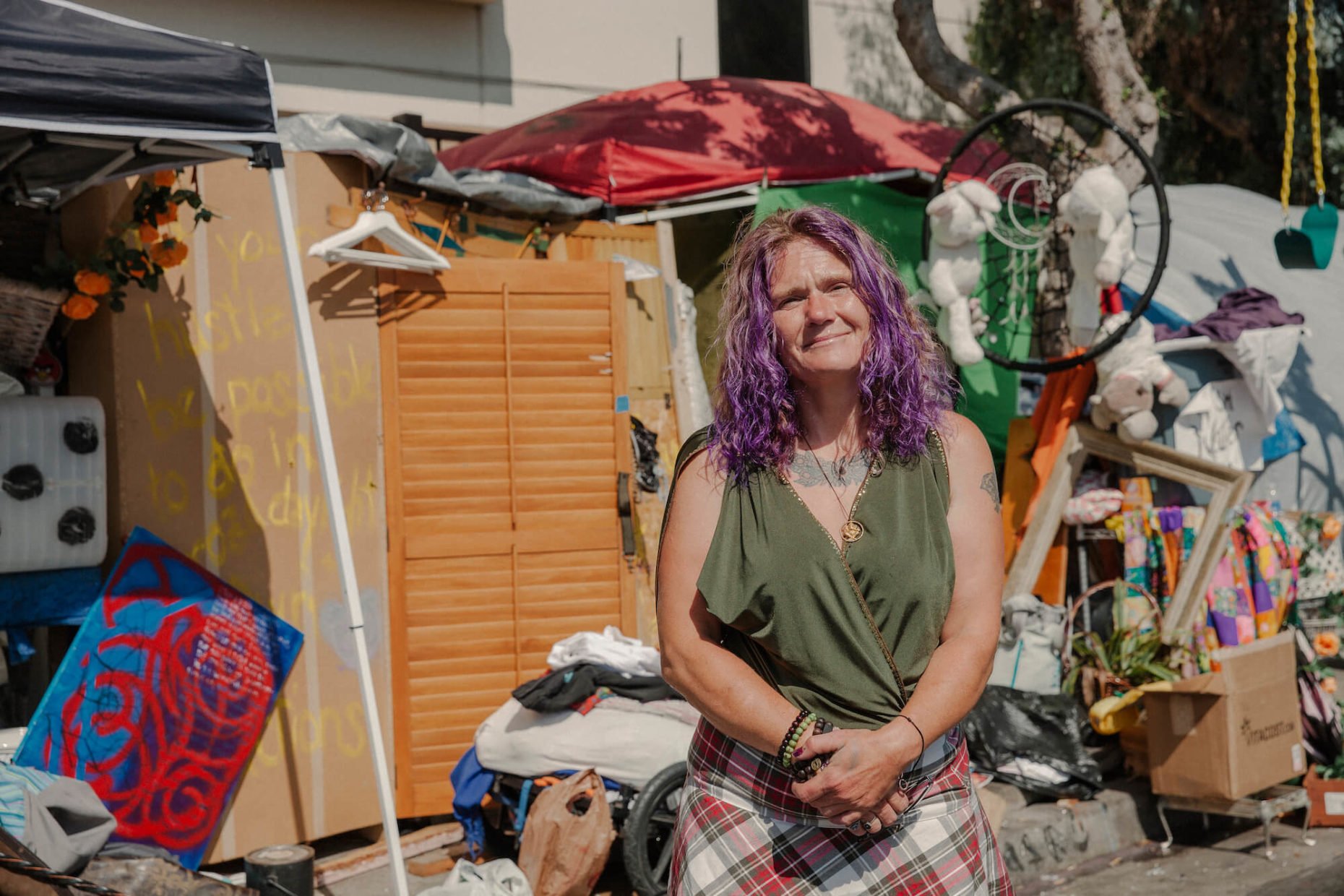
The boardwalk clean-up made Linda worry that city workers were on their way up Rose Avenue to clear out her block. In anticipation, she opened a suitcase on the sidewalk and considered the contents of her tents, folded what she wanted to keep and placed those items in the case, and set aside the rejects in a wheeled cart.
Linda, who is in her 60s, has been in and out of apartments in various parts of Los Angeles, and unhoused for spells in between, since the 1980s. She had arrived across from the Rose, on Hampton, after a series of frightening episodes that she recounted one by one: Gang fights in one building that spilled into her apartment, a slumlord in another who let strangers move in and take over her place, her stuff stolen, her food poisoned. Recently she’d noticed a local security guard who had worked for the slumlord, she was sure, and thought it might mean trouble.
“I don’t know whether to stay or to go. It’s a sword they have hanging over our heads. It’s not good.”
“I thought it’d be better here,” she said. “Is it? No. There were rapes, gangbangers, guns in Santa Monica,” she said, where she had lived most recently, “and now they’re here in Venice. What are they doing following me?”
She thought she might go to Arizona, because it felt safer than Los Angeles, and because, she said, she had a small piece of property there. But first she had to get her belongings organized, and then she had to hope she could stay put until she got her second Pfizer vaccine, so that she would feel safe when she left the block. Linda had stopped taking what she called her “psych pills” because they dulled her senses. She felt safer without them. “The problem isn’t my mental illness,” she said, “which tells me to be very alert.”
For all the perceived threats of life on Hampton, her biggest concern was uncertainty. “I don’t know whether to stay or to go,” she said, staring down the block. “It’s a sword they have hanging over our heads. It’s not good.”
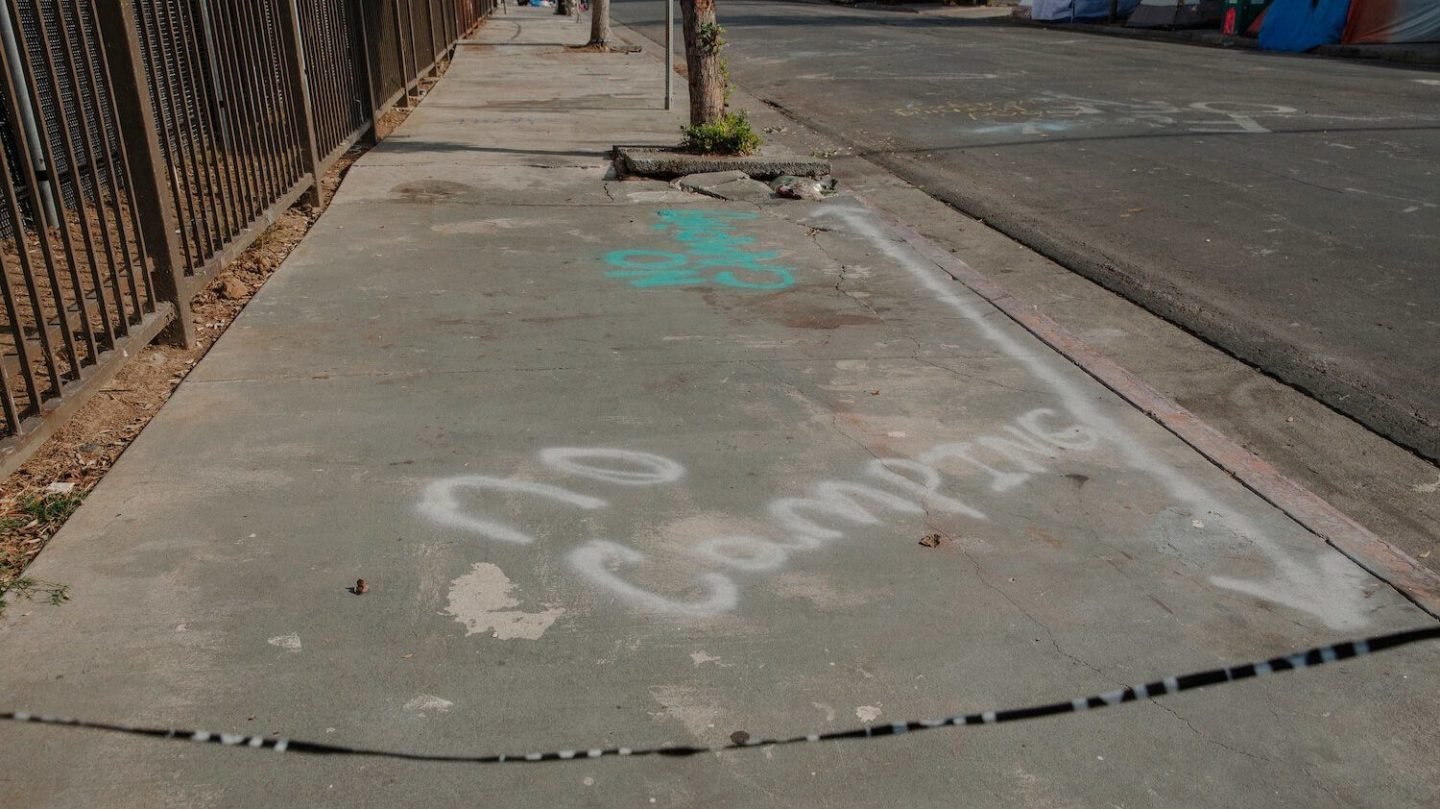
Neroni wondered what the boardwalk clean-up meant, as well. He hoped it was the start of a resettlement campaign that would include Hampton Drive and Third Avenue—but he worried it was merely a move engineered by Bonin to show up the county sheriff, a one-shot effort on the most public stretch of tourist real estate.
He waited for some action, whether it was a clean-up or a meeting with the councilman, and kept up his incident log as the high-traffic summer ticked by. A naked woman dashed into the Rose and out a back exit. A clearly agitated man got in through the back patio entrance and took a table, as well, and Neroni had to get him back outside. He didn’t want to make trouble for the people living quietly in their tents on the street, but this was something else, a threat predictable only in its unpredictability.
The possibility of change started to take shape on July 28, when the L.A. City Council voted 13-2 to approve an amendment to municipal ordinance 41.18, an anti-camping rule that made it illegal to sit, sleep, or store belongings on specific kinds of public property like schools, libraries, and parks, or any place that “obstructs the public right of way.” But it wasn’t a binary move; it didn’t mean that living on Hampton Drive would be legal one day and illegal a day later. The city council had to vote on whether to enforce the ordinance at a proposed location, and then to post signs announcing intent, followed by a 14-day waiting period before taking action. A city report estimated that it could take up to four months to clear out an encampment, and that presupposed a city councilperson who supported the measure and identified areas in his district that should be part of the effort. Mike Bonin had voted against it.
Gjusta was a lightning rod for the debate over Venice’s future—a high-end bakery, deli, market, and restaurant that opened in 2014 a block south of the Rose on Sunset Avenue, at the opposite end of what was now the Third Avenue encampment. A Gjusta hamburger cost $19, and a club sandwich was $20, and that, along with a crowd that could afford not to think about price, caused a backlash among longtime residents who considered Gjusta to be an unwelcome interloper. They saw it as the kind of business that was beyond the reach of people who laid claim to Venice but had more and more trouble affording it. Gjusta might be in Venice, but it wasn’t of Venice—and its location, just steps from Google’s offices, seemed to confirm its interest in attracting wealthier new customers.
The Rose charged $20 for a “Double Smashburger” and $26 for a pizza, but it didn’t draw public ire the way Gjusta did. History was on its side—a local icon, named for its street, got a relative pass, especially with a newcomer nearby to siphon off negative attention.
“I don’t care to listen to myself talk about losing business. My only story is public safety because there is such an extreme problem.”
Gjusta owner Fran Camaj could see the length of the Third Avenue encampment from his second-floor office window, and he could tick off the ways in which it had changed over the past few years. He knew the location of what he called the “bike chop shop,” a double-wide structure where he bought back his wife’s stolen bicycle for $20. He saw people using and selling drugs, “twice as much as I’ve ever seen,” and watched fights break out and subside. Over the summer, he said, two men chased a woman to Gjusta’s doorstep because she’d been recording what Third Avenue looked like on her cell phone.
The neighborhood hadn’t been an obstacle before the pandemic, when weekend customers faced a formidable wait, but business was down, and some of the one-star reviews on Yelp complained about the challenge of navigating a safe path to Gjusta. Camaj, who has lived in Venice since the 1990s and has three children, insists, though, that business is not his primary concern. “I don’t care to listen to myself talk about losing business,” he said. “My only story is public safety because there is such an extreme problem.”
Unlike his restaurant neighbors, he had no expectation that the city would address homelessness in any meaningful way, because the city had failed to, so far. Camaj defined progress as improved co-existence, which seemed to him an attainable goal. As a first step, Los Angeles needed to replace super-structures with individual tents that are easier to keep clean and would re-open the sidewalks to pedestrians. Everyone would be better off.
“Venice could get stronger or fade away, and that would be quite a loss. People are welcome here, we look out for each other, that’s why there are so many people here. This gave me back my will to live.”
“If I was the city’s enforcement arm, in charge of what should humanely be done, then the super structures are just eliminated,” he said. “You’re allowed to have a sleeping bag and a small tent, and you’re not going to jail for being on the sidewalk. But you are absolutely not allowed a shelter that takes over a sidewalk multiple people are supposed to use. How can that be disguised as being humane?”
“My snap-of-the-finger thing would be to get uniform, city-of-Los-Angeles tents, provide a clean, brand new, waterproof structure,” he said. “There is no silver bullet, but as a step one.”
Short of that, Gjusta remained a sometimes challenging destination for people who had the resources to enjoy it—and a different kind of challenge to the people who couldn’t afford to, and who worried that its sibling restaurant, Gjelina, was one of the most popular spots on Abbott Kinney Boulevard. Gjusta might be an outlier, or it might be a harbinger of things to come on Rose Avenue. Not even Camaj could say, as long as things stayed the way they were.
Georgeanne Ayers lived in one of the rambling Third Avenue structures that Camaj wanted the city to outlaw, and had propped a large whiteboard in the middle of the street to announce her presence: “Know the facts. If you really knew the factors and all the factors of my situation (and many others) your opinion of us would shift and chances are you would see ‘Our Truths’ and Apologize. Take the chance and stop + speak to ME. Ask away.”
She had lived there for two years, she said, and as she got to know her neighbors she had embarked on a project to help them out. Ayers turned her home into a general store where people could look for what they needed, a sweatshirt or some socks or a toothbrush, and take it, or trade it, or give her a little money for it, whatever they could manage. She looked for inventory in trash receptacles—in the uppermost layers, the stuff that hadn’t been sitting there for too long—and was always grateful to locals who bagged up usable items and set them on the sidewalk next to the trash, knowing that someone might want the contents. She accepted donations from her neighbors on the street as well, from people who thought someone else might need a particular item more than themselves.
“The space is mine, but I can’t seem to get it done. Everyone needs something, and they’ll stop me from getting it done.”
Ayers had become too successful; her inventory spilled out toward the curb and past the temporary side walls of her space, blurring the line between her store and the part of the structure she lived and slept in and making it hard for her to organize two distinct areas. “The space is mine,” she said, “but I can’t seem to get it done. Everyone needs something, and they’ll stop me from getting it done.”
Those everyones were as close to family as Ayers got, and she started to cry as soon as I asked where she came from. Pennsylvania and a family of “misfits,” she said, four children, one of them dead before he could get off probation and join her in California, and relatives who would not let her talk to her two youngest children, though she intended “to take that on, but not now. I have to wait until I have some resources.”
Resources required stability, which had eluded her so far. She’d traveled for a while before she found Venice, and now all she wanted was to stay put. “I like what I see,” she said. “Venice could get stronger or fade away,” she said, “and that would be quite a loss. People are welcome here, we look out for each other, that’s why there are so many people here. This gave me back my will to live.”
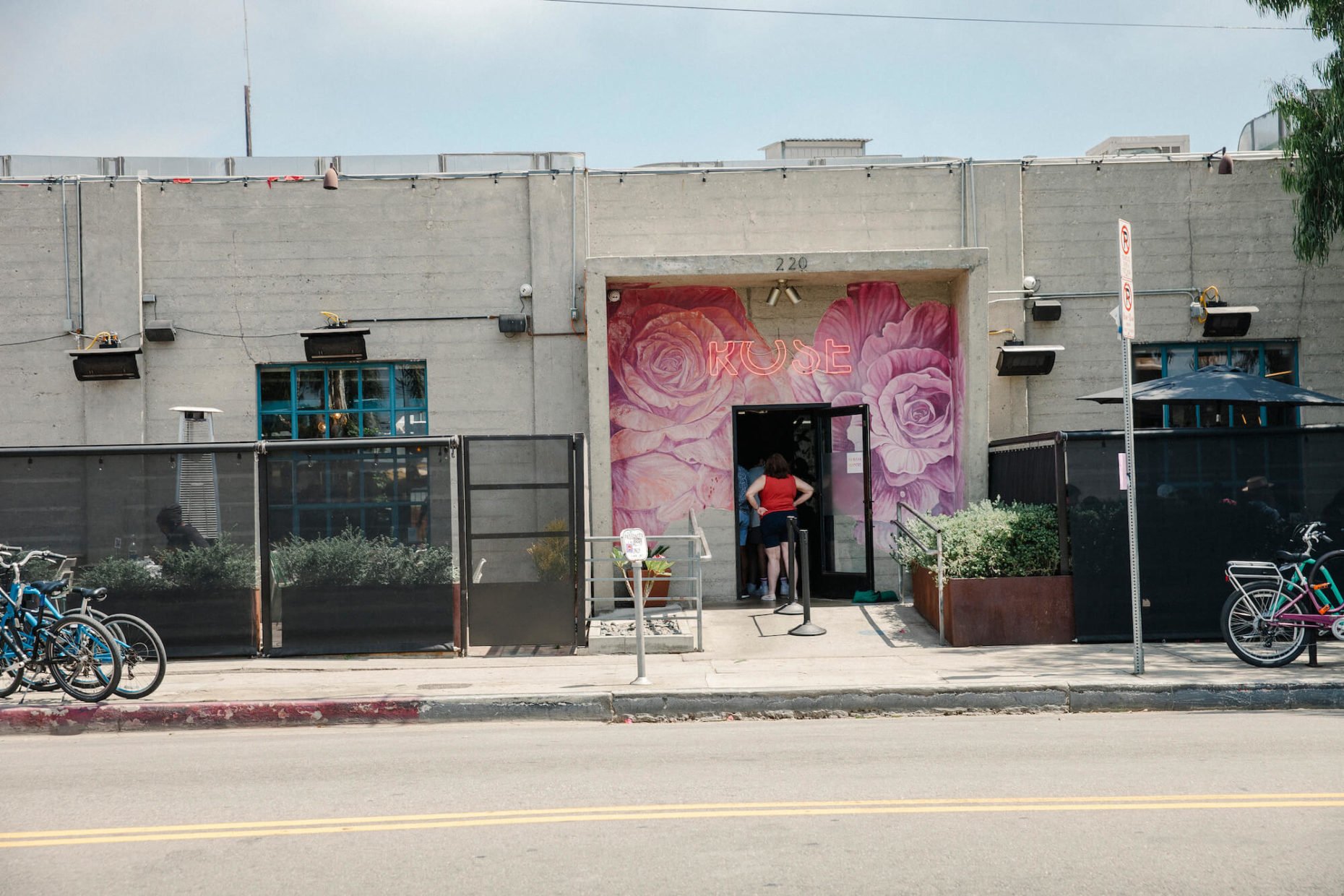
Almost three months after Neroni’s first email, on August 5, Councilman Mike Bonin arrived at the Rose accompanied by four uniformed LAPD officers and one of his staff members. Neroni’s contingent included his wife, Jennifer, and representatives of his business partner’s management company and the family that owned the Rose.
They sat on the restaurant’s back patio as Neroni pressed for answers, and afterward, the chef and his wife tried to make sense of what had just happened. When he complained about his unanswered 911 calls, one of the officers assured him that response time was six minutes, and when Neroni disagreed—“That’s not true in our case”—the officer explained that to get an immediate response he needed to say he was calling about a violent incident in progress.
The rest confused him, so Jennifer consulted her notes. “He did say he’s committed to doing more enforcement around here, but enforcement of what?” There had been no mention of the anti-camping amendment, which was scheduled to go into effect on September 3 but required Bonin to nominate the area for clean-up. There might be more thorough street cleanings that would require people to abandon bigger structures for more portable ones, but that was just a return to the way things had been before the pandemic.
Neroni appealed to his wife: Did she think their complaints had registered?
“I don’t know,” said Jennifer. “He certainly made it look like he was listening. But I don’t know.”
If a 911 caller says that a violent crime is in progress, officers know to “drop everything [they’re] doing and respond straight to that call,” said Captain Steve Embrich, commanding officer of LAPD’s Pacific Area, which includes Rose Avenue. But if a Rose Venice manager said that a guy is standing on the corner acting out, it was a non-priority call, unlikely to get a response. That was the crucial distinction Embrich and his officers had tried to convey to Neroni.
“It happens all the time,” said Sergeant Brian Cook, who also attended the meeting at the Rose and is responsible for eight senior lead officers on the west side of Los Angeles. “Communicating the facts of what is actually occurring, and the immediacy, sometimes does not happen.”
The LAPD draws criticism from both sides of the Rose Avenue conversation: advocates who fear another incident like the Echo Park clean-up across town, where an estimated 100 officers participated in a contentious, surprise dismantling of a large encampment, and residents and businesspeople who want officers to be more aggressive. But LAPD’s mandate, according to officers responsible for neighborhood enforcement, is defined by three operational lists: What they used to do and can’t, right now; what they never did, despite what people think their job is; and what they wish they could do.
“Homelessness is just a symptom of the actual problem, which is mental illness or narcotics abuse. You have to deal with that problem, and not just one of its symptoms, because otherwise you’re just moving the problem indoors and out of sight.’”
What they can’t do is enforce ordinances that have been suspended during the pandemic. It used to be illegal to keep a tent in place between 6 in the morning and 9 at night, and to park any vehicle anywhere for more than 72 hours, or on weekly street-cleaning days. Now it isn’t, which has led to super-structures, people living in lone parked cars, and rows of campers that don’t move.
What they’ve never done? Intervened in any but the most serious incidents involving mental health issues, because they have no mandate to do so. The city has no dedicated mental health budget, and the county is stretched thin, but the county and nonprofit service providers are supposed to handle all but the most extreme incidents. The LAPD steps in only if a situation meets one of three criteria. “There is always outreach encouraged before any type of enforcement effort,” said Embrich. “We only get involved once somebody is in crisis and they are a threat to themselves, or to others, or they’re gravely disabled, in which case we would do a 5150 mental health hold.”
That’s not what local residents want to hear. “People will call and say, ‘You’re not doing anything with this person,’” said Cook, “but sometimes they don’t meet the criteria for us to detain them. It’s not illegal to be mentally ill.”
“When it’s all over, we just see people pop up in other places.”
What the officers wish they could do is enforce drug laws in a way that motivates drug users to seek treatment. Proposition 47, passed in 2014, reduced drug possession from a felony to a misdemeanor and retroactively cut sentences to align with the new guidelines. It was designed to keep people out of jail for minor possession charges, but the officers are focused on unintended consequences: Lighter penalties, combined with cheaper and more powerful drugs, and super-structures big enough to protect sellers and buyers from discovery by the police, have led to an explosion of drug use that has redefined the neighborhood.
“There’s always the threat of violence,” said senior lead officer Acosta. “If anybody has any kind of means, or ways of having another place to go—families that lost a job, in other parts of the city I know of families that are living out of an RV, with kids—they’re not going to be in the Venice area,” said Acosta, “if they have the choice to go somewhere else that is not so active.”
Halfway through my conversation with the three officers, Embrich broke in to make sure his priority was clear. Drugs are “the second biggest factor after mental health issues as far as persons we get into violent confrontations with,” he said. It would “perhaps be looked at as one of the key changes that led to the expansion of homelessness and addiction.”
Karen Lauterbach, at the Venice Family Clinic, saw the same problem from a completely different angle. “Criminalizing it doesn’t help anyone, doesn’t make them say, ‘Oh, right, you’re right, I won’t live on the street anymore,’” she said. “And that criminal record will impact their ability to get a job—if you have two applicants, one with a criminal record and one without, who do you go with?”
But Embrich is adamant. “Homelessness is just a symptom of the actual problem,” he said, “which is mental illness or narcotics abuse. You have to deal with that problem, and not just one of its symptoms, because otherwise you’re just moving the problem indoors and out of sight.’”
The challenge of helping the city’s over 41,000 unhoused people had spiraled out of reach of the various groups who continued to argue about the best approach.
In the meantime, the best he could offer Rose Avenue restaurateurs was a list of practical steps to reduce the likelihood of a confrontation. They could lock their bathroom doors and post a sign saying that bathrooms were solely for customers’ use, and block exits if they couldn’t control who came in and out. If they posted no-trespassing signs, an officer might be able to detain someone, assuming the call got answered in time. And restaurant people could work together on a more coordinated effort—if the street meant that much to them, they ought to communicate about how best to preserve its character.
The LAPD was available to share such advice, if asked, but relied on local business owners to initiate the conversation or ask for a meeting. Owners who weren’t aware of the option, like the restaurateurs on Rose, expected the police to take the first step, and felt neglected when they didn’t.
Door locks and signs were hardly a perfect solution, but Embrich had come to understand that there wasn’t one, that the challenge of helping the city’s over 41,000 unhoused people had spiraled out of reach of the various groups who continued to argue about the best approach. It wasn’t really a solution at all, just a series of protective measures, but at least it was a start.
Sanitation workers and LAPD officers arrived on Hampton Drive on the morning of August 19, and by 11 a.m., the sanitation team had cleared out the southern half of the block, its residents told to get what they could carry off the sidewalk; the rest would be thrown away. This was not an extension of the boardwalk clean-up. There were no St. Joseph volunteers with the promise of already-arranged temporary housing, no transportation to that housing, no conversations about available services for people who were not yet ready to move. Venice Family Clinic wasn’t there to connect with people who might relocate and be hard to find for their weekly injections or other medical care. It was, effectively, a restoration of existing city services, nothing more. The difference, this time, was that the encampments had changed and grown over almost 18 months of suspended city activity. It was one thing to pack up a tent, quite another to pack up a structure and its contents.
The clinic’s Lauterbach was exasperated by the lack of coordination with support services, which fairly guaranteed that nothing would change except for people’s locations. “When it’s all over,” she said, “we just see people pop up in other places.”
If the unhoused community in Venice reflected the cumulative effects of the economy and the pandemic, so too did the restaurants that lined the street. Three of them sat in a row a block down from the clinic, equidistant from the encampments and the row of campers at the eastern end of the strip, each one a distinct point on the street’s timeline.
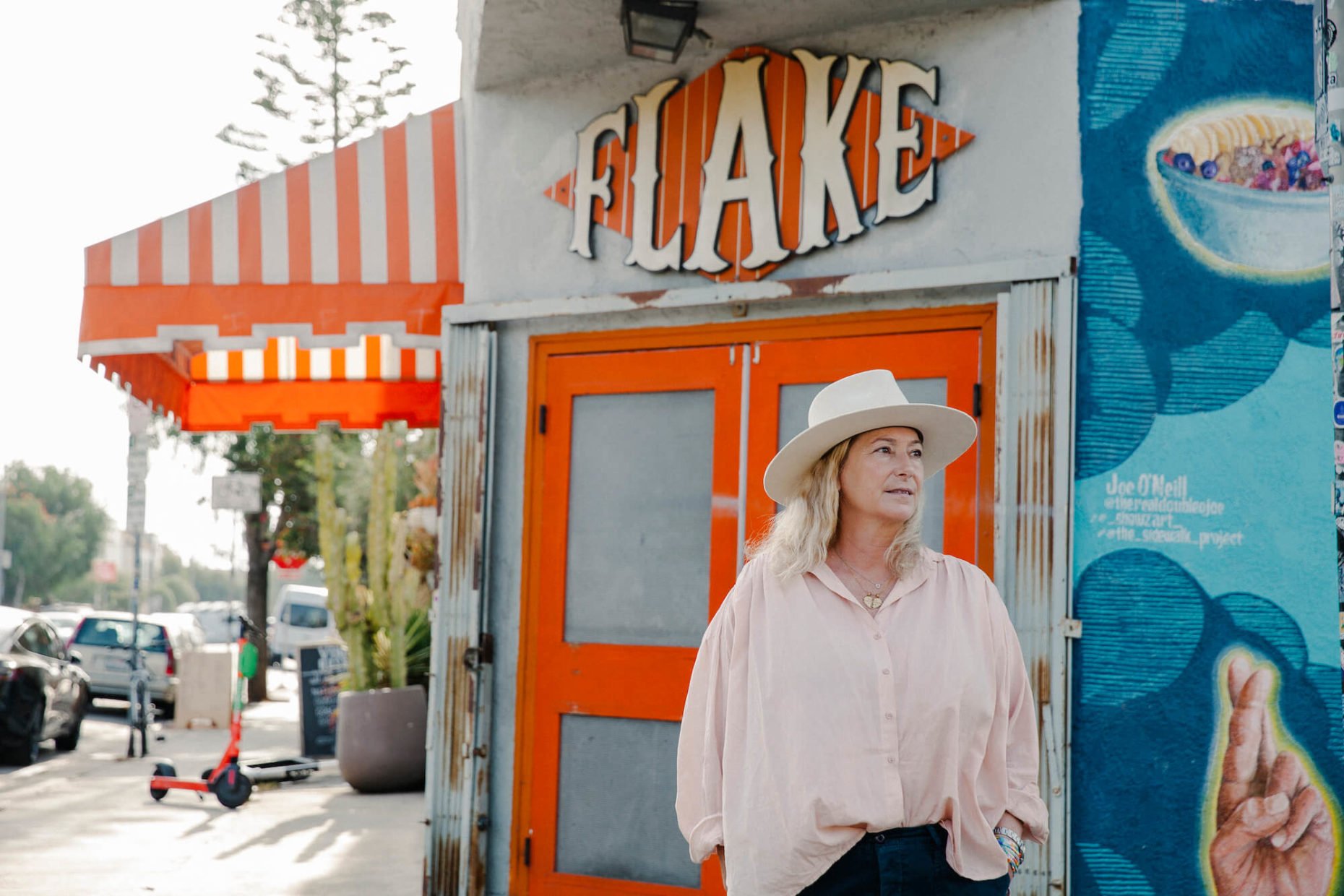
Paige Clay, who opened her breakfast-and-lunch place, Flake, in 2008, is the kind of owner who passed on the chance to build parklet outdoor seating—she didn’t want to deprive her neighbors of parking spaces they desperately needed at night. She’s eliminated indoor seating and relies primarily on take-out, with just a handful of spindly tables and a bench alongside the building, but Flake is still, she said, “an anchor spot for the community.” A knot of people gather around the order window early on weekend mornings.
It’s a low-key operation, from the sun-faded awning to the hand-painted mural proclaiming Flake the “House of the Cro-Jo,” a breakfast sandwich built on a croissant. This isn’t cuisine, it’s what Clay called “cheap and cheerful” food, designed not to awe but to make her customers happy, including many neighborhood restaurant workers who can afford her menu but not the ones where they work. She uses American cheese on the burritos and sells sandwiches with names like The Fatty, the Happy Hippie Wrap, and Bubba’s Basic. During the peak summer season, she works the line assembling salads and sandwiches while her cooks make the hot dishes.
“After Google and Snap came in, things really, really changed. The clientele skews younger, with much more disposable income. And just not as invested in the community. It’s not the same.”
Lately Clay felt a “menacing” squeeze from both ends of the economic spectrum. When she opened Flake there had been fewer people without a permanent place to live, and less of a divide between those who had resources and those who didn’t. “It was different for homeless people when we started,” said Clay. “They lived in their vehicles, for the most part, and they were part of the larger community,” including a man who worked for her as a dishwasher. She fed people all the time, simply because she had food and they didn’t.
If she fed them now, it was often part of a barter negotiation to get them to move on. “If you’re dealing with someone who’s mentally competent it’s easy,” she said. “It’s, ‘Hey, if I give you a sandwich will you take yourself down the street?’ But today there was a guy sitting on my bench, just hollering. There are more people on the street who are mentally ill, or have a dual diagnosis, that and drug or alcohol addiction, and it scares people.”
She’s had people overdose in her bathroom, and confessed to occasional “empathy fatigue,” which she believes is widespread among restaurant people who feel ignored by city officials, and manifests itself in practical questions about enforcement gaps.
“I do believe there are laws on the books that if we just enforced them, we might not be in this mess,” she said, unaware of the enforcement moratorium. “There’s no sleeping on the beach, so why aren’t we enforcing that? There is no overnight parking. Or if I park on street-cleaning day and don’t move in time, I get a ticket, which I have to pay because I don’t want my car impounded. If I park a food truck somewhere it’s not supposed to be, they’ll tow it away. So why do campers just sit there?”
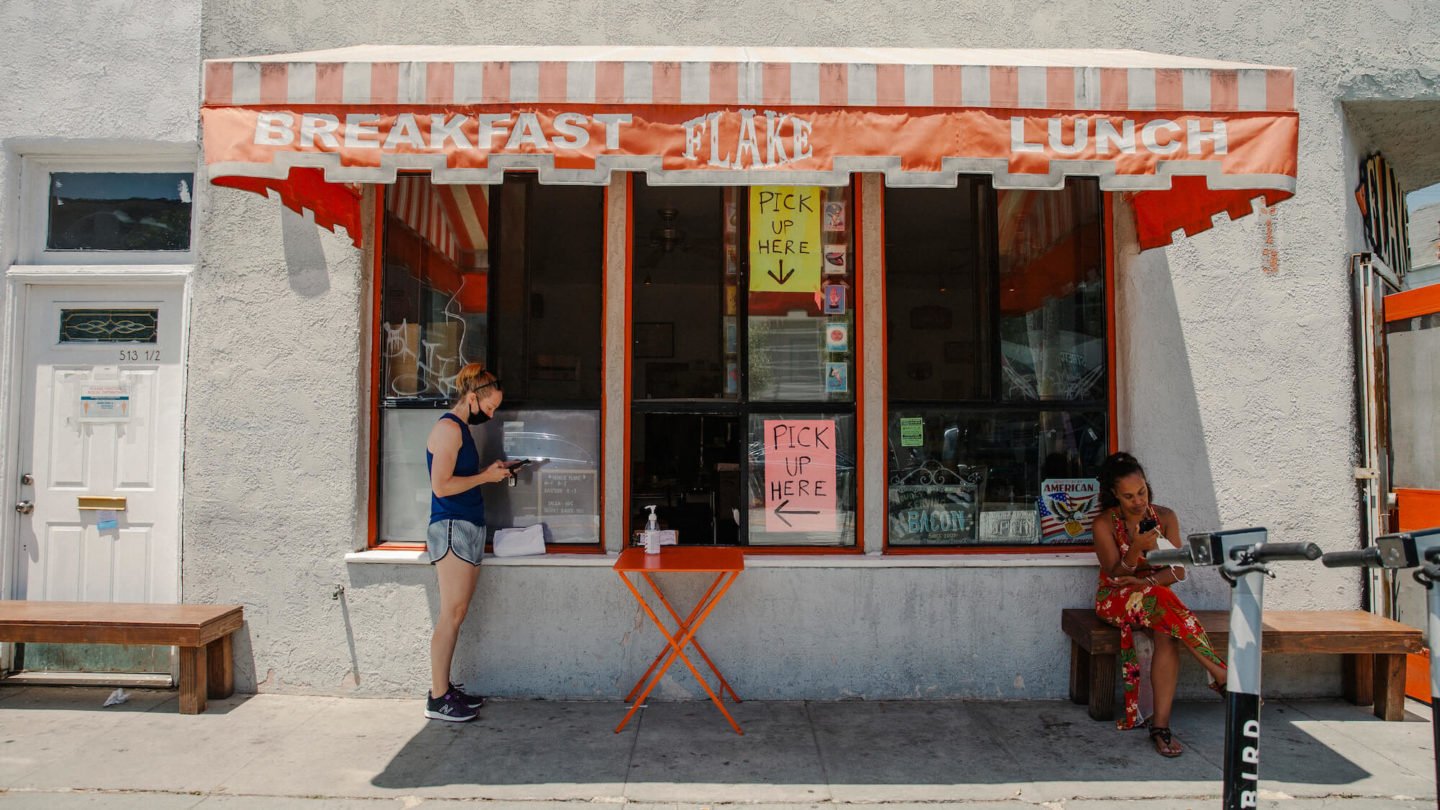
She was equally frustrated by the influx of big spenders who made weekend nights on Rose “absolutely insane,” from what she’d seen, and grateful that her day ended at two in the afternoon. Flake used to attract “artists and young families,” she said, but many of those original customers had been priced out of the area.
“If I have to come down here in the evening it’s shocking to me,” she said. “After Google and Snap came in, things really, really changed. The clientele skews younger, with much more disposable income. And just not as invested in the community. It’s not the same.”
Joshua Woollen, a 22-year Venice resident who lives just down the street from Flake and is a regular customer, was drawn to the neighborhood at first, he said, because of its “edgy style—as vast as L.A. is, Venice is walkable, bikeable, all-encompassing, and once you’re here you find the community gathering places.” Now he is warier than he used to be.
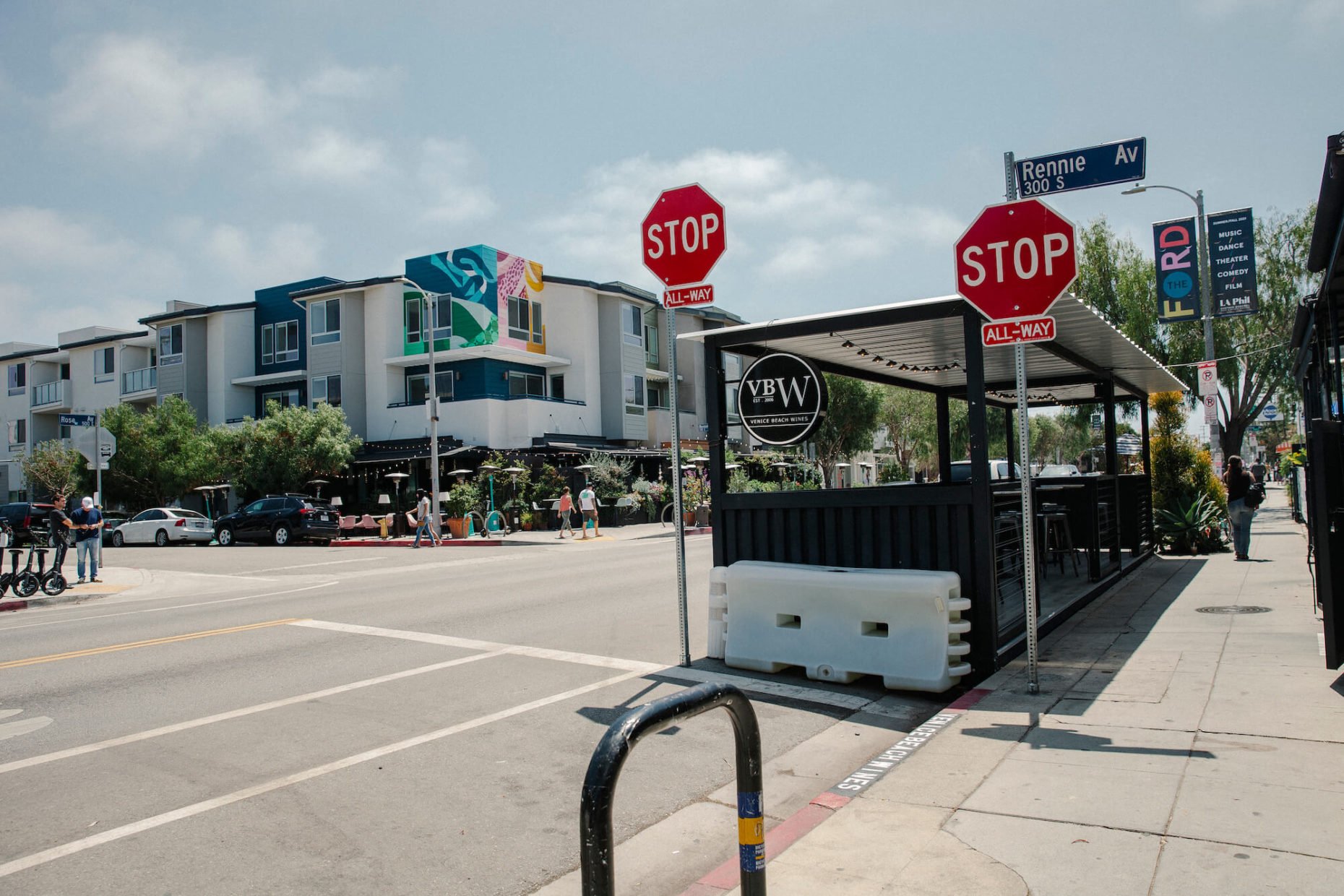
“I might be heading to a restaurant for dinner,” he said, “but I might choose not to walk down Third Avenue, or even cross to the other side of Rose, because someone’s acting out. And I’m extra-cautious with my kids, who are 11 and 14. I keep them close.”
“Outside my door there’s lots of non-positive engagement, violent incidents that people don’t know how to deal with,” he said. “There’s always been a population on the streets, but this is the worst I’ve seen since the late 1990s.”
Oscar Hermosillo and Norma Alvarado own Venice Beach Wines (VBW), a half-block up from Flake, which opened as a wine store in 2006 and was converted to a restaurant in 2010. Before that they spent 16 years as social workers, so they look for the overarching solution, not the street-level strategy, but Hermosillo doesn’t see much to give him hope. Existing interventions are doomed to failure, he believes—and viable alternatives don’t exist, and are unlikely to any time soon.
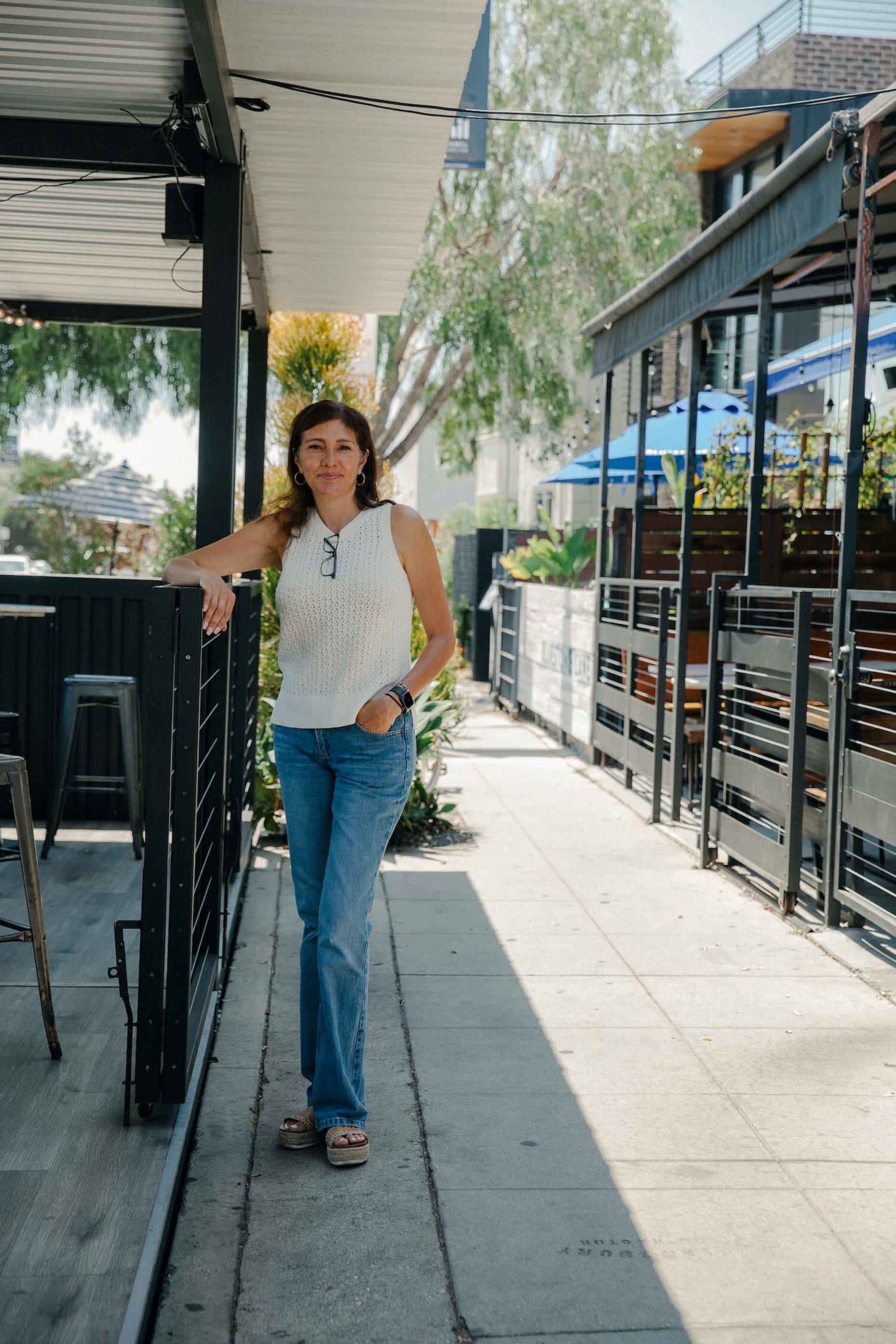
The neighborhood had become “a ticking time bomb,” he wrote in an email, because of people “peddling strong, more aggressive drugs to the needy.” He dismissed street clean-ups as “a Band-Aid” that scattered people throughout the neighborhood rather than finding housing for them, “admirable in its intent but short-sighted.” A more lasting solution would require two things in short supply—a broader, coordinated effort among groups too often antagonistic toward each other, and more money. Creative thinking would help, as well: Hermosillo liked the idea of taxing companies that use public infrastructure, like Amazon and Google. He’d like to see a tax on every mile an Amazon truck drives in 90291, the Venice zip code.
Failing that kind of change, the couple was left to address problems as they arose. When they got a call from another business owner who’d seen people sleeping in VBW’s parklet, they installed a locked gate.
Rose Avenue means everything to Tony Gutierrez, the operations manager at Chulita, a three-year-old Mexican restaurant a few doors up from Venice Beach Wines. He’d landed there after 10 years of working at various L.A. restaurants, but Chulita was the work-home he’d been looking for, and he was determined to protect it—and his neighbors as well. If LAPD wasn’t going to show up when there was a problem, he would figure it out himself.
“They’re allowing us to become the authority,” he said, so he did. If he sensed a problem with someone, he tried talking first, “because sometimes that’s all they need, the homeless, is a word. They spend a lot of time alone. I talk to them the way I want to be talked to.” If that didn’t work, he signaled the guys who worked there to step forward, for a show of strength. As a last resort, he had a baseball bat stashed in the host stand, “not to swing, ever,” he said. “It’s to scare people off.” He broke up one fight between two men who seemed high just by yelling at them to “bring them out of their state of mind.”

“I felt good about it,” he said. “I did my part.”
Chulita’s corner location gave him a good view of nearby restaurants, and as the summer wore on he became the block’s self-appointed guardian—not quite the collaborative effort LAPD recommended, but better than nothing. One night a man punched him in the chest and then took off down the block, so Gutierrez sprinted to Venice Beach Wines to warn Norma Alvarado, in case it was the next stop on the man’s itinerary. “This guy looks normal, but he’s off his rocker,” he told her.
Mr. William Earle Jones sees himself in a role similar to Gutierrez’, “a monitor,” he said, who bicycles down the street to keep an eye on younger Rose Avenue residents, offering advice on how to stay out of trouble. His motor home sits alongside the Whole Foods parking lot at Rose and Lincoln: He bought it at that location a year ago, and it doesn’t run, so that is where he lives.
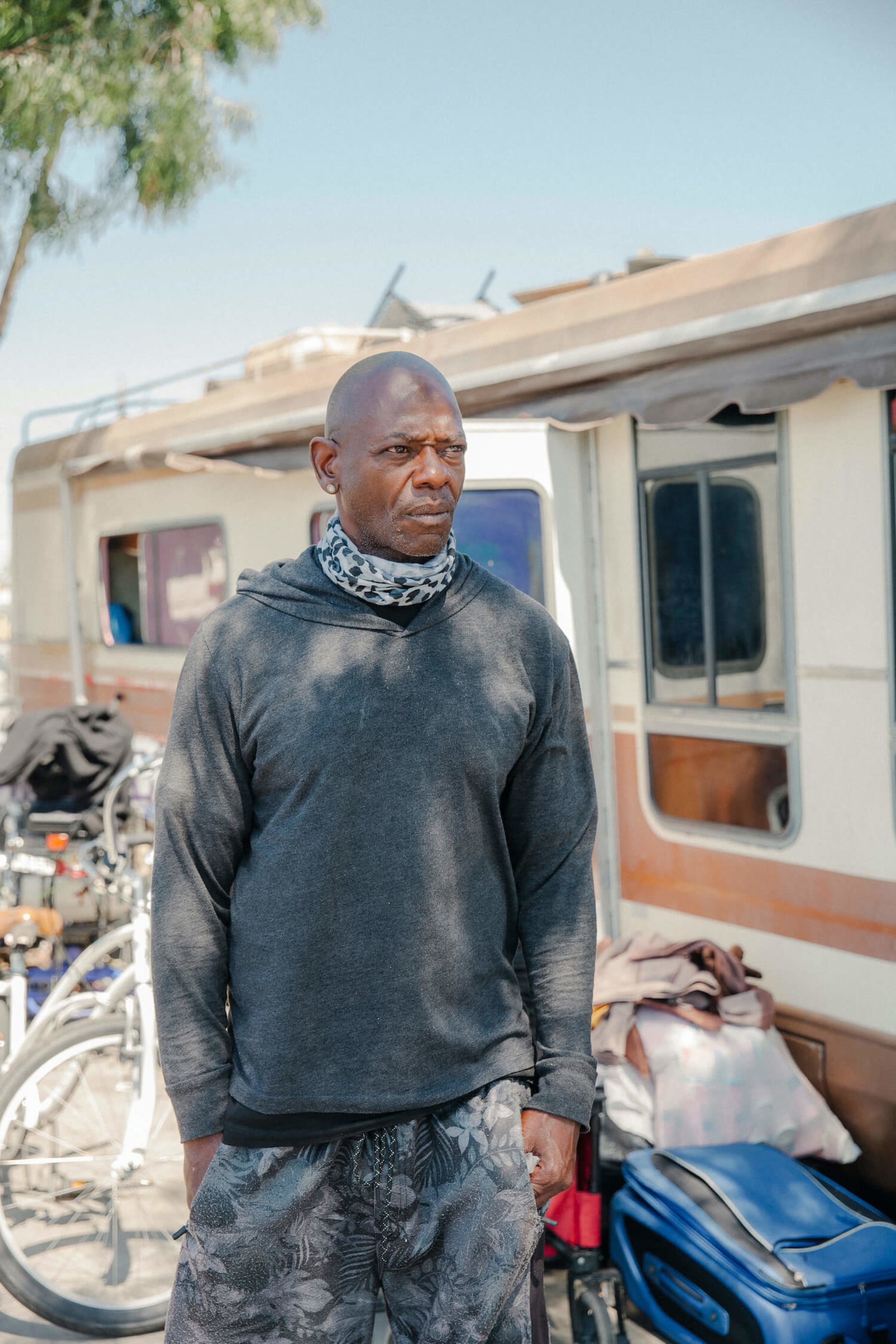
Before the pandemic, he was a courtesy clerk at a Westside market, working the parking lot, helping customers and workers, but he lost that job during the shutdown. Now he sat outside among possessions that included a chair, a bicycle, and other items lined up along the sidewalk. He has a mailing address on Hampton, and said that he was owed a good deal of money that hadn’t yet arrived, including unemployment checks, an income tax refund, and more. Mr. Jones last had a home address in 2014, and since then he’d seen a run of bad luck he summed up as his “predicament,” including a shelter he had to move out of, a fiancée he broke up with, and his current inability to find a job.
But his time on Rose has given him a new mission: to warn people about fentanyl, which is, as far as he is concerned, the primary obstacle to getting off the street and into housing and a job. “My job is to keep fentanyl out of this community,” he said. “I’m with the cops on that. It’s not party drugs out here, it’s fentanyl, and they’re putting it in everything.”
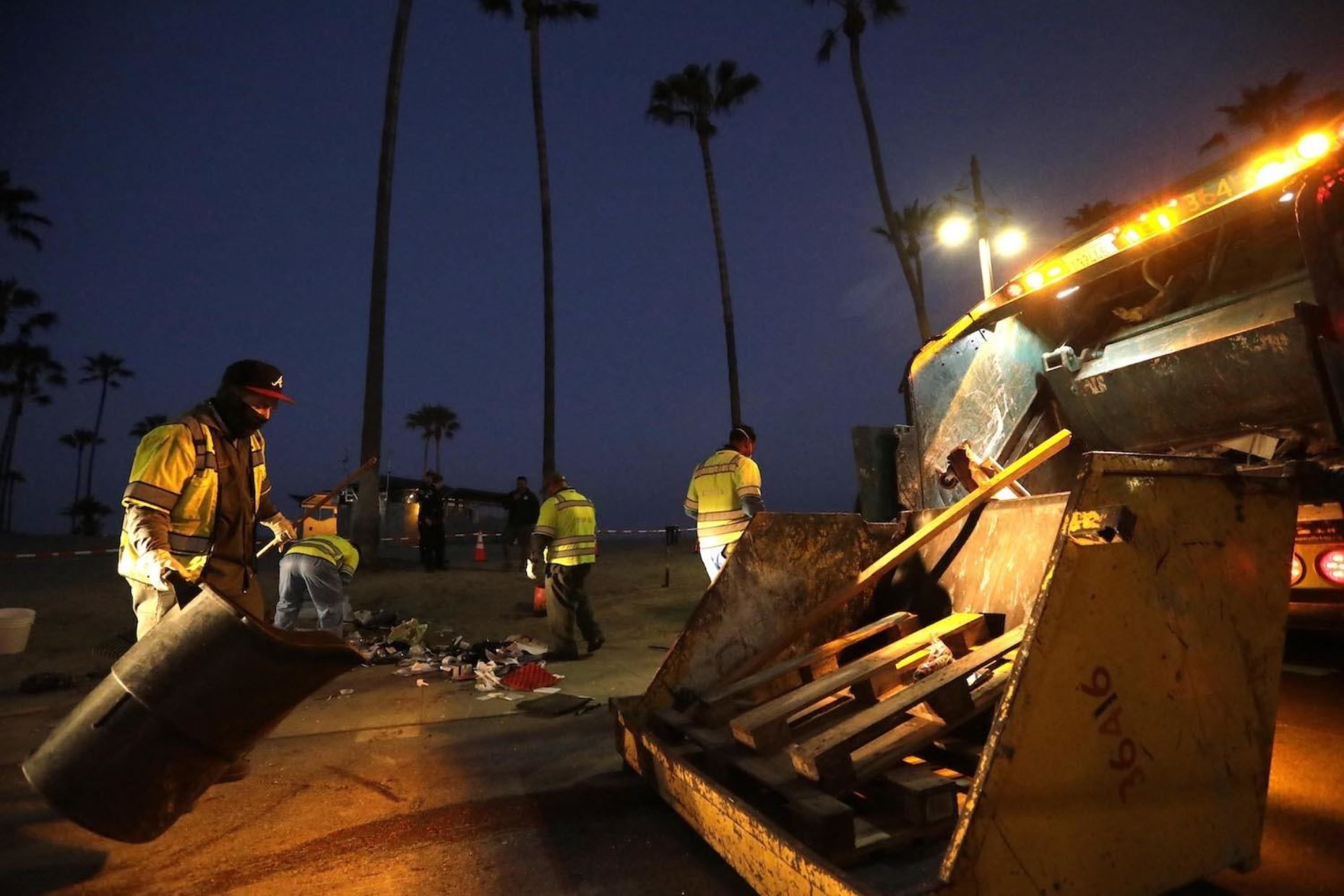
On September 9, LAPD parked SUVs sideways across Rose Avenue, blocking the entrance to Third Avenue, and ran yellow caution tape to cordon off sanitation workers as they embarked on another round of street-cleaning, this one more challenging because the encampment was much larger than the one on Hampton Drive. And possibly more contentious: LAPD officers stood close to the workers and garbage trucks to provide support as residents found out they had to relocate.
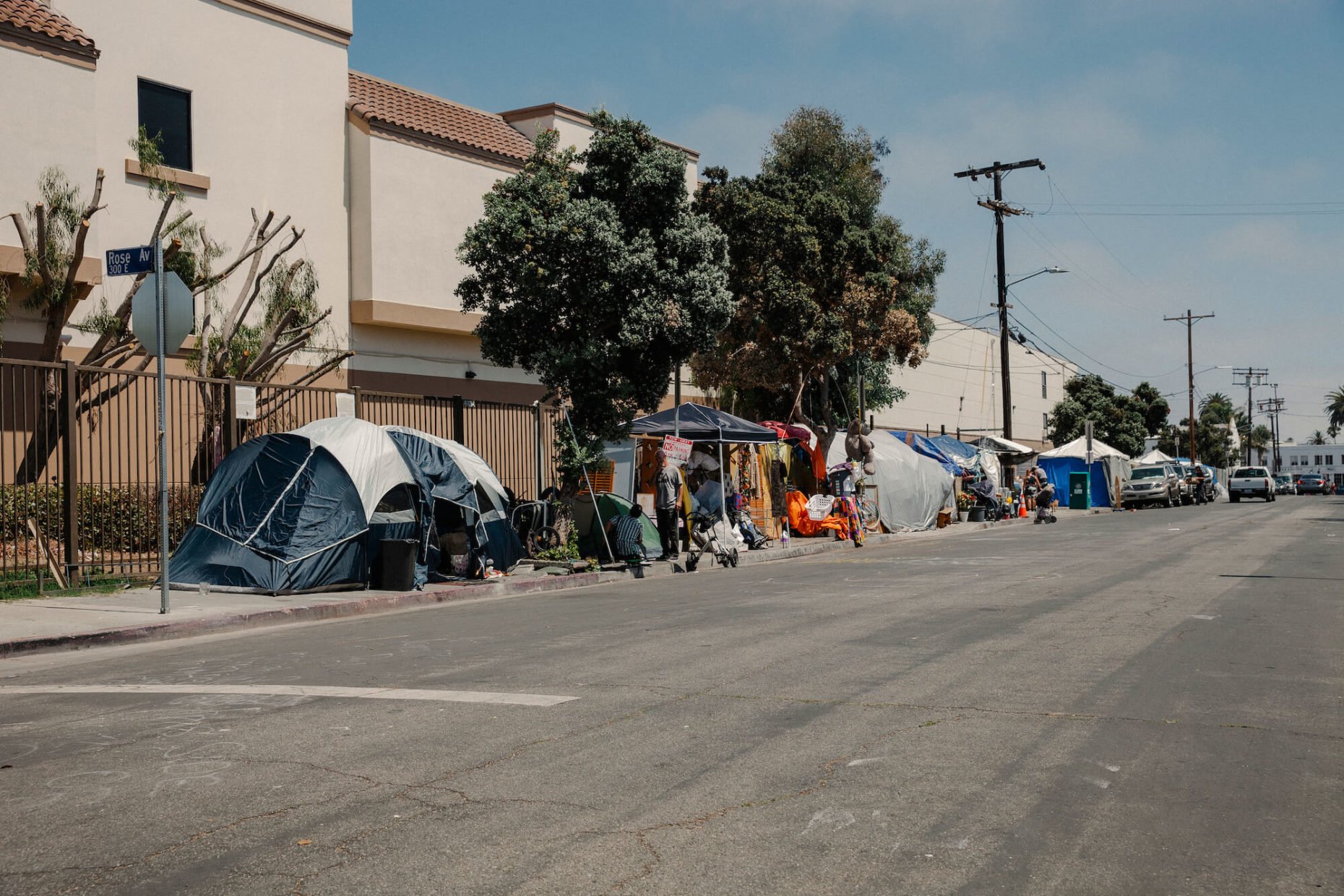
The amendment to municipal ordinance 41.18 may have gone into effect officially over Labor Day weekend, starting the clock on a potential no-camping enforcement, but in the meantime the city was back to cleaning Hampton Drive and Third Avenue.
By mid-morning one couple had hauled a pile of their belongings, including a mattress, to the other side of Rose Avenue, where they watched the proceedings, half their possessions on the sidewalk, half spilling into the street. Other people dragged what they could around the corner, onto Rose Avenue. Some grabbed essential items—posted signs advised them on how to protect or store documents and valuables—and watched as what they left behind was hoisted into garbage trucks.
“My job is to keep fentanyl out of this community. I’m with the cops on that. It’s not party drugs out here, it’s fentanyl, and they’re putting it in everything.”
No one had alerted the Venice Family Clinic or St. Joseph, and as the day wore on a quartet of clinic employees wandered the space, looking a bit shell-shocked and talking quietly among themselves, trying to figure out if there was some way to be of use. An advocate for unhoused people ducked under the caution tape and started to take photos of the signs and the workers, until a local woman loudly confronted her. The woman’s mother had been knocked down by an unhoused person, she said, so how could the advocate defend their right to be here? The advocate suggested, as loudly, that one person’s mom was not the center of the problem, and they were off, voices raised, insults hurled, until a man driving by on a motorcycle pulled over to join the fray. He had a daughter with mental health problems who was on the street, he said, waving his helmet menacingly, for emphasis. That was the priority. The two women didn’t know what they were talking about.
A young man who had dragged his tent onto Rose stepped over and began to tell the motorcyclist about his own mental health issues, in a low, calming voice, and just like that, the group split up, each headed in their own direction, possessed of the same absolute positions they’d held when they first raised their voices.
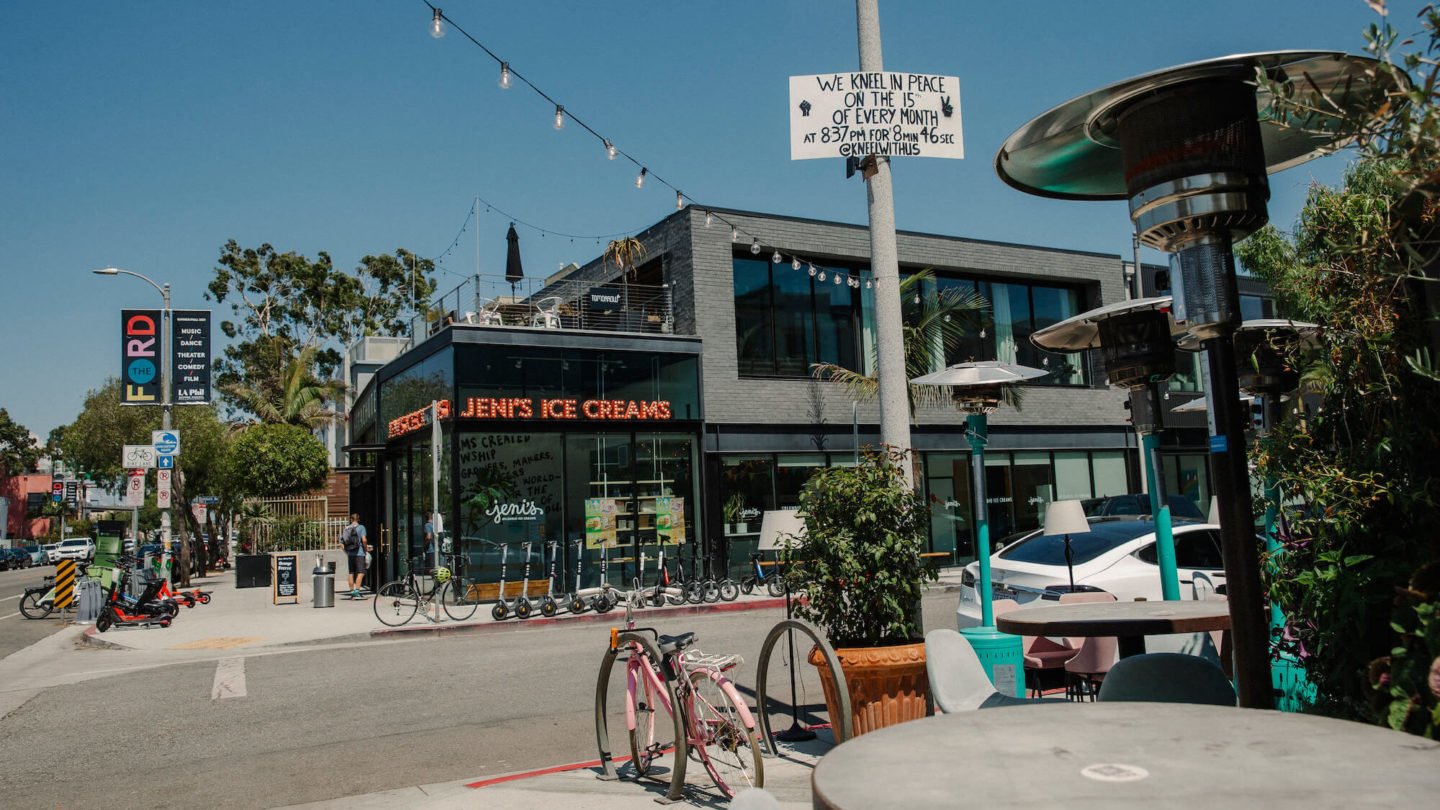
Rose Avenue represents a sliver of the nation’s unhoused population—over 580,000 people in need of permanent housing, 39 percent of them Black, 23 percent of them Latino, 20 percent of them children, all facing a reduced life expectancy because of the time they have spent on the street. Cities across the country face impossible life-or-death choices: In Washington, D.C., city officials asked the mayor to postpone a plan to clear out two encampments from December until March, when hypothermia would be less of a threat to people who either refused offers of housing or were not on the list to receive such offers.
In that context, what happens on Rose might seem small, but it is part of a repeating pattern in urban centers across the country, hardly the only place where the pandemic has redrawn a neighborhood. Up and down the West Coast, urban business districts that aren’t yet at full capacity are home to a growing number of people who lack permanent shelter and gravitate toward areas where they are more likely to be left alone. Portland, Oregon, chef Vitaly Paley closed restaurants in three downtown hotels and blamed the combination of a dormant downtown and an increase in the number of unhoused residents nearby. And in Denver, the locally-based Teriyaki Madness chain closed its only corporate-owned outpost and cited the same combination of empty offices and unhoused people living in the area.
Up and down the West Coast, urban business districts that aren’t yet at full capacity are home to a growing number of people who lack permanent shelter and gravitate toward areas where they are more likely to be left alone.
Seattle and San Francisco face a situation more similar to the one in Venice, as an increasing number of unhoused people move into business districts that rely on both local residents and tourists—the downtown area around Seattle’s famous Pike Place Market and Pioneer Square, and San Francisco’s Tenderloin and Market Street neighborhoods. But the sheer size of Venice’s population dwarfs what’s going on in Seattle, and the city’s director of economic development chose to promote that fact, telling a local public radio outlet that the city was “damn lucky” the problem wasn’t any worse, and suggesting a shift in focus toward that positive message. San Francisco, whose unhoused population has been an intractable problem for four decades, settled a 2020 lawsuit with Tenderloin residents and merchants who accused the city of using their neighborhood as a “containment zone,” and promised to make “all reasonable efforts” to relocate people to temporary housing or safe overnight spaces. A group of Market Street residents and businesses filed a similar suit a month later.
In its recent report, “Outside the Law: The Legal War Against Unhoused People,” the American Civil Liberties Union in California suggested a dramatic redefinition of the issue, calling for legislation to make the homeless population a protected class, safe from discrimination based on their housing status. Such legislation would shield the unhoused from arrest, disruptive clean-ups, and any actions based on where and how they live, and would require cities to “[i]nvest in subsidized, permanent affordable housing, social housing and services.”
California’s track record on that front is less than promising: The New York Times columnist Jay Caspian Kang, who endorsed the ACLU report, wrote that the state had “effectively squandered $2.7 billion in bond resources” that should’ve been spent on affordable housing. Los Angeles, for its part, had appealed an April 2021 court order to place $1 billion in escrow, immediately, to supply housing to the entire population of the city’s Skid Row within 180 days—and in September, a federal appeals court struck down a portion of the April decision that calls its entire future into question.

Councilman Mike Bonin stands 180 degrees from LAPD officers who said that drug use and untreated mental health issues lead to homelessness. From his vantage point, too few permanent beds is the central problem, and finding more of them the only path to a solution. “If I’m living on the street and I get sober,” said Bonin, who is 26 years sober after struggling with alcohol and methamphetamine addiction, “I’m still homeless. Getting people inside doesn’t magically make them sober, but it’s a lot easier to do indoors.”
The city needs more permanent beds even if people have to spend time in temporary housing before they make the transition. And it needs more drug and mental health recovery services to help them do it successfully, all of which take time and money. If he had enough resources—and if he survives the recall next spring and wins the general election—Bonin is confident he could meet his goal for Rose Avenue by the end of his final term: “I’d hope people won’t be living in tents or RVs on Rose. I wouldn’t say I’m rosy and optimistic, but I’m focused and determined about it. It can happen.”
“It’s key. When somebody says yes to housing, you have to have someplace for them.”
“Getting people inside doesn’t magically make them sober, but it’s a lot easier to do indoors.”
He admits that his vision of the future depends on optimal conditions, while real life is anything but. Venice can greatly increase its housing supply only if increased funding continues, if more city council members support the 10-year housing vouchers the federal government has made available to end the cycle of temporary housing followed by a return to the street, and if there are sufficient wraparound services to provide mental health and addiction care. If someone solves the “chronic” problem of high real estate prices on the west side, which make it harder to purchase or lease potential housing. If someone can figure out inflated per-unit costs and reduce them.
The city “doesn’t have all the resources in its menu” to make the plan work, he said, conceding that his approach might require a controversial change in the criteria for involuntary commitment of the mentally ill. It pains him to say so, but Bonin thinks there needs to be a broader definition of what it means to be a danger to oneself, to allow for interventions with people who can’t function on their own.
“People can try to legislate homelessness away, but it doesn’t work. You can say, ‘You can’t be homeless,’ but that doesn’t make you housed.”
But as far as he’s concerned, housing is the only viable option of the three currently under contentious debate. “There’s the status quo, where everyone loses,” he said. “and criminalization perpetuates the cycle, disconnects people from services and housing, and pushes the problem to another block or neighborhood.”
Bonin’s critics are anything but patient, which frustrates him. “Not everybody in Venice has been here for 15 to 20 years,” said Bonin, who has lived in the area since 1991, “and they say, ‘Who’s this guy who says we need to have homeless housing here?’ But it’s been a 20-year conversation. At some point the umpire has to call the play.”
“People can try to legislate homelessness away, but it doesn’t work,” he said. “You can say, ‘You can’t be homeless,’ but that doesn’t make you housed.”
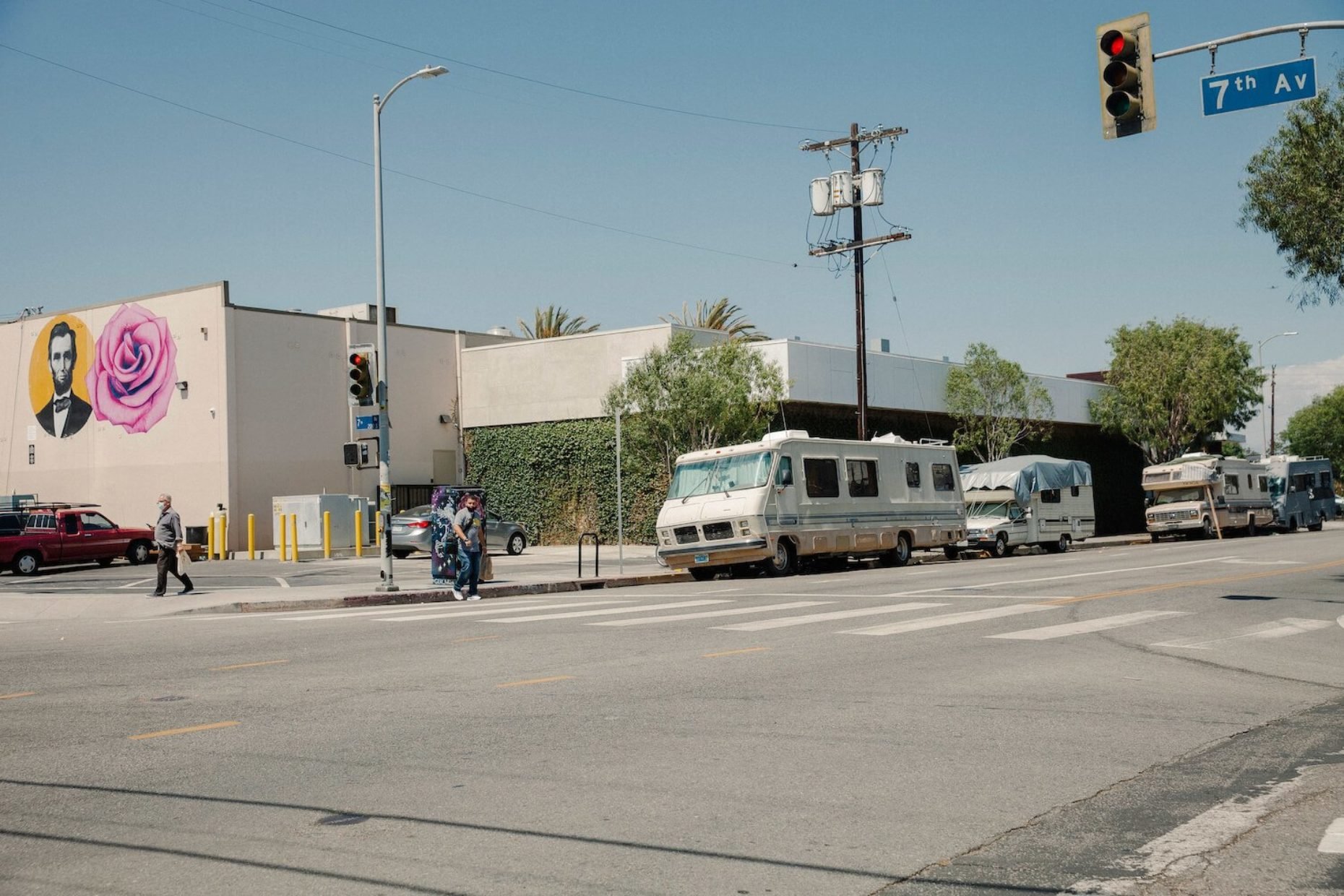
Whatever becomes of Rose Avenue, it won’t be the street it should be. That is George Francisco’s harsh appraisal, and he offered to walk down Rose Avenue with me to explain how it was supposed to look, a rare opportunity for him to describe his vision without being shouted down.
His vision for Rose Avenue is “European,” he said, in the tradition of its namesake and other European cities known for walking streets that mix storefronts at ground level and residential space upstairs. There would be public parking at Lincoln Boulevard, so that people from anywhere, tourists or residents of other L.A. neighborhoods, could find easy parking—a serious enticement in a city where circling for blocks searching for a space is often the reason people decide to stay home.
“Rose Avenue is what many people want. We want to go where the locals go, go to the indies, they want to be first on the scene and find something new and different.”
That way, the city could eliminate the parking requirements that currently hobble Rose Avenue businesses. And liquor licenses would be easier to get, not to turn the street into one long pub crawl but to make it easier to sell drinks, which is where restaurants make most of their profits. More mixed-use permits would enable the owners of residential buildings to lease their ground-floor space to a small business, while owners of single-story businesses could add housing upstairs and increase the area’s strapped inventory.
Even the block-long storage facility at Third and Rose had potential, though an earlier effort to transform it had failed: There was plenty of space between the building and the Rose-facing sidewalk, just the place for small covered businesses, from food pop-ups to artists’ galleries.
The street would be independent, not corporate, full of smaller businesses like the ones already trying to get by on Rose. There were no encampments on Francisco’s imaginary street, but that’s what got him back to angry. The city and the nonprofits weren’t getting enough done.

Voters had approved a bond measure in 2016 that would have authorized up to $1.2 billion in housing funds. Legal challenges delayed action until 2018, and a year after that the conversation turned to whether shelters were a better idea than permanent housing, which meant further delays. He wasn’t the only one to wonder why construction on some projects seemed so expensive, and why land south of Los Angeles International Airport wasn’t being considered more seriously as potential space for new housing.
Francisco had yet to hear answers that satisfied him—in fact, they only confirmed his suspicion that people were making money off either inaction or questionable projects. He’s debating whether to continue at the Chamber of Commerce after his current term expires next summer, and in July he retired from the Venice Neighborhood Council. He closed our conversation with his rewrite of the last lines of Chinatown, a movie about an earlier, more corrupt Los Angeles.
“It’s Venice, Jake.” There was pretty much nothing left to say.

Developers, a group with a vested interest, stayed silent by choice. But Phil Brock knew what they were up to, and that they might already be deciding Rose Avenue’s fate. Brock, a longtime Santa Monica resident and first-term city councilman, comes to the conversation with a unique set of credentials: He was mugged in Venice at gunpoint along with his wife, in 1980, and won’t live there, he said, because “I like the eclectic and creative, but I don’t like the danger that’s mixed in.” He inherited two rental properties from his father, in 1997, and lately had fielded cold calls from developers asking if he’d like to sell his four-unit rental property across from the storage facility and the Third Street encampment. He turned them down, but he knew what the overtures meant. They’d like to be in his shoes, in line to make a great deal of money when today’s Rose Avenue yielded to what they assumed was coming, a repeat of what had happened to Abbott Kinney.
Brock hoped they were wrong, because there were customers—he considers himself one of them—“who don’t want a repeating pattern of the same stores and restaurants over and over. Rose Avenue is what many people want. We want to go where the locals go, go to the indies, they want to be first on the scene and find something new and different.
“Three, four years from now, Rose Avenue follows Abbott Kinney, and you force out both the current residential and the commercial.”
But there were relative bargains to be had on Rose, and no guarantee that the developers who approached Brock cared about preserving the street’s character.
“Rose Avenue prices are lower than Abbott Kinney,” he said. “And developers want to buy on Rose because on some blocks, at least, you can do mixed-use, maybe have some ground-floor retail. They’re imagining it’ll all be cleaned up eventually, so if they can get in now and hang on long enough, they’ll make millions.”
In Francisco’s dire scenario, Venice remained a neighborhood of extremes, and nothing got fixed. In Brock’s, the value of beachfront property would eventually prevail. The specifics of what would happen to Rose Avenue’s unhoused population, in either case, were yet to be determined—precedent ran from tiny-house developments to safe-parking areas to the sudden dismantling of the Echo Park encampment, to solutions that would take years. But one way or another, Brock anticipated a tectonic shift.
“Three, four years from now,” he said, “Rose Avenue follows Abbott Kinney, and you force out both the current residential and the commercial.”
“It feels inevitable,” he said, “though I’m not entirely sure.”

No one was, about much of anything. Half of the sidewalk on the east side of Third Avenue was emptied out to make room for a construction project at the storage facility—a new second fence installed inside the existing one, this one topped with barbed wire to discourage people like the one who had abandoned a mattress inside the first wall. A cleaning crew returned to empty half of the west side of Third, a job which lasted a couple of weeks before people circled back and set up their structures again.
In May, the neighborhood homeless population had occupied a geometric grid. By the end of September they were floating in various directions, dislodged, but not gone. Not housed, most of them. Just moved.
And Neroni gave little ground: If things were better for him by the fall, and maybe they were by a little bit, it had nothing to do with the city’s revived efforts. It had to do with him closing the rear entrance to the restaurant, beefing up the staff at the front entrance host stand, and being quicker to call security.
On November 10, supporters of the effort to recall Mike Bonin submitted about 39,000 signatures for the city to review. If just over 27,000 are valid, a decent bet, Bonin will face a recall election in May, weeks before the June general election in which he hopes to win a third and final term.
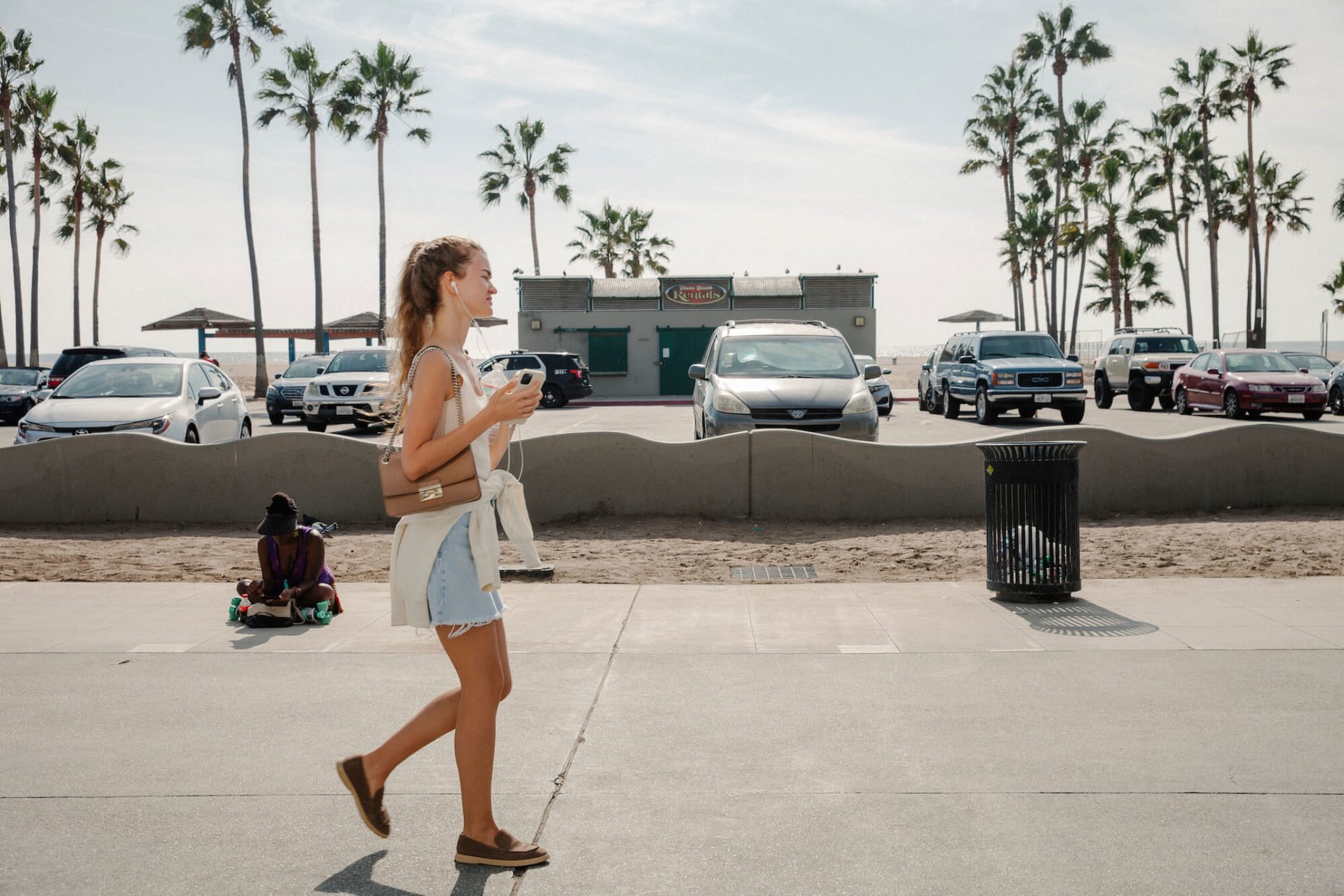
Mr. William Earle Jones’s motorhome was in the same spot in September, as immobilized as ever, even as a neighbor worked on her camper because she’d heard rumors that street cleaning might eventually get to the eastern end of the street. I couldn’t find Georgeanne Ayers, whose general store was part of the first Third Avenue street-cleaning. Linda’s two tents disappeared and a scruffier one took their place, but then, one day, I saw her pulling a cart south along Hampton to what turned out to be her new home, in a less prominent location on the opposite side of the block. She said a Google employee had accused her of panhandling and told her to move, and her explanation—“I don’t ask for money, people give it to me”—seemed not to make a difference. A man who already lived on the other side of the block helped ferry her stuff to the new spot, which would be home unless the sanitation crews returned.
Small new settlements appeared on Rose Avenue around the corner from Third, in a nearby parking lot, and on a grassy triangle alongside the campers on Main Street, where someone had hung their newly-washed clothes on the chain-link fence to dry. A few tents sprung up on a side street or two, and slowly, parts of Hampton and Third filled up again.
The boardwalk and the encampment by the sand were almost empty, dramatically so compared to what they had been in June, and on fall weekends Venice Ale House was full of people eating and drinking and having a good time. But there were tents further down the sand, toward the water, and a bench or two were occupied by people who had artwork or souvenirs for sale, in front, and a blanket or tarp or tent, behind.
When I got to the base of Rose Avenue one afternoon, I pedaled north from the Ale House to the bike path, and passed a man struggling to turn a tarpaulin into a three-dimensional shelter, his belongings piled on a nearby bench. He sat down for a moment to catch his breath, just as a grey-haired, shirtless man on a bike, heading south, looked over and recognized a familiar face.
“Hey,” he yelled, veering happily toward the man on the bench. “Welcome back.”
Published in The Counter.
How to tell if that peach is ripe? Ask Southern California’s ‘Produce Hunter’
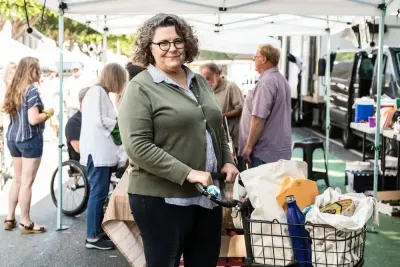
Shopping at the Santa Monica Farmers’ Market, Karen Beverlin reached into a five-pound box of tart Belle Magnifique cherries, grabbed a couple and ate them.
Shopping at the Santa Monica Farmers’ Market, Karen Beverlin reached into a five-pound box of tart Belle Magnifique cherries, grabbed a couple and ate them. Tart cherries are tricky to size up at a glance: Flavors can range from gently tangy to very sour, and just looking at them offers no reliable clues. All Ms. Beverlin had to go on was her palate. She ate a few more, and smiled.
[Read] The New York Times | https://www.nytimes.com/2019/08/26/dining/produce-hunter-karen-beverlin.html

Breaking out of the pink ghetto
For decades, the typical restaurant kitchen in the U.S. operated on faulty logic: Women can’t cook. Baking isn’t real cooking. The conclusion? Women can bake.
[Source] The Los Angeles Times
For decades, the typical restaurant kitchen in the U.S. operated on faulty logic:
Women can’t cook.
Baking isn’t real cooking.
The conclusion? Women can bake.
The savory side, the hot line, was considered the “real thing,” said restaurateur Nancy Silverton, the only chef to win James Beard awards for both outstanding pastry chef and outstanding chef. Baking meant following rigid recipes, which was women’s work — at least to the men who did the hiring.
But female bakers, exiled to the pink ghetto of the pastry kitchen, built an alternate kitchen culture as different from the savory side as its inhabitants were. It has become a land of opportunity for women, not a dead-end but a first step toward better restaurant jobs or their own bakeries, cafe-retail hybrids, food trucks and stalls — whatever a young entrepreneur might come up with.
While it happened around the country, the spine of the story runs through California. “It could only have happened here,” said Michael McCarty, who opened Michael’s in Santa Monica in 1979 and gave Silverton her first pastry job. “Anyone can reinvent themselves here; it’s fundamental to the place. And early on, you had chefs who said, ‘Hey, I live in California. I can do whatever I want.’”
Baking is no longer women’s fate. “The bakers who work for me are all where they want to be,” Silverton said. “These people like the dessert world. It’s definitely a choice.”
::
On a recent Wednesday, the morning bakers at the Manufactory in downtown Los Angeles, all of them women, came to work before the sun was up to get the morning’s pastries into the oven, the first of three shifts that ran until 8 that night. The big kitchen was an airy, quiet place, populated by cooks who spoke in low tones if they spoke at all.
They share a skill set with their predecessors — an attention to detail, a mastery of precise techniques, a talent for the minute adjustment that makes all the difference. But these days, sous chef Anna St. John said, female bakers come to work with “momentum” — an eye on a promotion or a place of their own — and a dessert-without-borders approach to the future.
“The pastry kitchen used to be very polite,” St. John said. “Now it’s just badass.”
The unlikely revolutionary who started it all was the first pastry chef at Berkeley’s Chez Panisse in 1971. Lindsey Shere, now 84, started baking when she was 9 and never considered whether it was less challenging than cooking. She was surprised to learn that some of the men in the kitchen did.
“Occasionally an attitude would come out in some way,” Shere said, “but I really didn’t think too much about it.”
She ignored a colleague’s overheard comment that a pastry chef isn’t a “real chef” rather than try to correct his mistake. “It was just a microcosm of the time.”
Shere agreed that cooking and baking were different. “You can’t adjust things midstream” with baking,” she said, while “cooks could work on the fly, change things as you go along.”
What she didn’t buy was the prevailing belief that cooking was art, while baking was a glorified home-ec project. In fact, she didn’t see the need to compare them and declare a winner at all.
She was insulated by lucky circumstance. The Chez Panisse pastry kitchen was located at first in a small cottage behind the restaurant, so she was largely shielded from what the cooks were saying. She worked for a woman, co-founder Alice Waters, was 10 years older than most of the staff and had a family, which meant she missed what she called “a pretty wild scene” after hours. She put all her energy into developing a seasonal dessert calendar that generations of California bakers have adopted — a tectonic shift in an era of year-round French desserts.
Shere preferred the pastry kitchen, with its small, close-knit staff and lack of competitive hierarchy.
To this day she has no idea why most men stay away from baking, though she was prepared to float a theory or two. Maybe a “mother thing” put them off, she said — the idea that dessert was a treat, inessential, something a mom might turn out for a family celebration. Or maybe men were uncomfortable in a kitchen where women ran the show.
“Partly,” said Shere, with a hint of a smile, “I’m sure they feel seriously threatened.”
::
The dessert landscape in Los Angeles in 1976 was bleak — a few French or Jewish bakeries and restaurants that served “bought desserts” from outside suppliers, Silverton recalled. That was fine with her. After a year at Le Cordon Bleu in London, the last thing she wanted was a pastry job.
“I still had PTSD from that,” she said, “Because you’re learning the basics and there’s no flexibility. You’re an executioner. ‘Can I use less sugar?’ ‘Can’t I cut down the amount of gelatin?’ Everything was ‘No!’”
But baking was a “foot-in-the-door job” in the kitchen at Michael’s in Santa Monica, so she took it. Three years later she became the first pastry chef at Wolfgang Puck’s Spago, where her approach had nothing to do with polite women making paint-by-number sweets.
Silverton combined Shere’s use of local, seasonal ingredients, along with the techniques she’d learned, to create signature desserts — and she never let up. When her first child was born in 1982, she gave herself a long weekend before showing up at Spago, newborn in tow, “not full-time or anything,” she said, “but to check to see how everything was.”
Like Shere, she enjoyed the autonomy of the pastry kitchen, where each cook made desserts from start to finish. “Everything we did, we did ourselves,” she said. “No line cook complaining about the mayonnaise or the size of the minced chives.”
But making innovative desserts wasn’t enough of a challenge for a woman who’d grown up surrounded, she said, by feminist role models. She wanted her own business.
In 1989, Silverton and her then-husband, chef Mark Peel, opened Campanile, with La Brea Bakery next door. If her Spago desserts bent the rules, La Brea Bakery pushed them even further. She elevated bread from an opening act to the main stage, and introduced pastries like her rosemary corn cake, whose sweet-and-savory descendants are now standard fare.
In 10 years La Brea had a wholesale business with annual sales of $200 million, and the couple sold it three years later. Since leaving Campanile and opening the Mozza group of restaurants, starting with Pizzeria Mozza in 2006, she has been much more involved in the savory side.
Although other bakeries focused on quality bread took off in California before La Brea — most notably Steve Sullivan’s Acme Bread in Berkeley — it was Silverton’s name that quickly became synonymous with great bread, in part because having a woman at the helm of a bakery was a novelty at the time.
“I made the possibility of great bread a reality,” she said. “And I’m a girl too.”
::
La Brea Bakery put the rest of the country on notice: California was a welcoming place for a female baker.
“‘If you have even the smallest amount of drive,’” a friend told baker Liz Prueitt in the early 1990s, “‘you will get very far ahead in California.’” Prueitt and her bread-baker husband, Chad Robertson, left the East Coast and eventually opened the tiny Bay Village Bakery in Point Reyes Station, followed by Tartine Bakery in San Francisco in 2002.
Tartine was a magnet for young female bakers willing to work crazy hours — both trained cooks and eager hopefuls who signed on as unpaid interns. Prueitt wanted to create a kitchen that could keep up with them, which meant reconsidering some of the gender clichés that consigned women to pastry in the first place.
“I’m not naturally an ‘attaboy’ person, which is so not-female of me,” she said, but she figured there had to be a middle ground between cutthroat and warm-and-fuzzy. She rejected chef coats that conveyed status, encouraged a comradely atmosphere as long as the work got done, and strove for a “two-way street” rather than a dictatorship. Outsiders, unable to grasp the new business model, asked Prueitt in the early days if Tartine was a collective.
It was a work in progress — as were the pastries, despite notions about the constraints of baking.
“People think of a baked good as a static snapshot, as something that must stay the same forever,” she said. She did not. Her own gluten intolerance inspired her to create new versions of old favorites and to encourage employees to come to her with recipe ideas, which is why rugelach made with einkorn flour ended up in her upcoming cookbook, “Tartine: A Classic Revisited,” being published in October.
“Collaboration is a very strong aspect of women working together,” Prueitt said. “There’s such a lovely thing when you really know what you’re doing, rolling out croissants, making cookies, and you’re just talking about your life.”
At 56, success and tired feet have taken Prueitt out of the kitchen on a daily basis; her job today is mainly focused on managing the workplace she created — multiple versions of it, including the L.A. Manufactory, a new Tartine at Inner Sunset in San Francisco and a bakery in Seoul.
It’s hard for her to talk about. “The reason it chokes me up,” she said, “is that I miss it so much.”
::
Zoe Nathan walked by Tartine on her way home from a line cook job in 2003 and stopped to watch the bakers through the window. “A bunch of girls,” she said, “and they had their tattoos, they looked like me, didn’t look flowery and soft. They didn’t look ‘nice’ at all, and I thought, ‘I want to be there. I want them to be my friends.’”
Nathan, now 37, was a veteran of kitchen harassment before it became a headline, including a stint on the hot line at Lupa in New York City, then part of Mario Batali and Joe Bastianich’s empire, where a male cook more than once followed her into the walk-in refrigerator to kiss her. She moved to San Francisco and a new job, but still felt out of place.
The morning after she passed Tartine, she walked into the bakery and offered to do anything, for free, in her off hours. They handed her a box of apples. “I cut them so fast,” she said. “I felt as though my social life depended on it.” She was offered a job as a morning-shift baker the next day.
Her schedule belied stale notions of the weaker sex: predawn shifts at Tartine, “living, literally, in a friend’s closet,” and a midday nap so she could learn about bread in the afternoon. Four years later she became the pastry chef at Rustic Canyon in Santa Monica.
Nathan eventually married Rustic Canyon restaurateur Josh Loeb, and they now co-own eight restaurants and an ice cream business. For over six years, until last summer, she stuck to a daunting workweek: After saying goodnight to the couple’s three small children, she arrived at work at 1:30 in the morning and then dashed home as soon as her husband called to say they were starting to stir.
At work, she encourages her staff to take risks, as she did, rather than stick to tried-and-true recipes. “I’ll still go in and say, ‘Throw this out, all five things you just made,’ but you know what? I say it to myself too.”
That, she said, is what a female baker looks like. “You can’t do this half-assed,” she said. “You go to bed at 8, you wake up very early, you don’t go out, you have to change your whole life. Bakeries are very fast-paced places. You have to be on it.”
::
The new threat is economic, but it’s an equal-opportunity roadblock: Pastry chefs, male or female, are “the first ones to go” when a restaurant needs to cut costs, said Antico pastry chef Brad Ray. “If you can’t pick up a knife and work in the savory kitchen too, you might be struggling to find a job soon.”
McCarty no longer employs a pastry chef, a response to how diners prefer to end their meals these days. “It’s the shared-plate thing,” he said. “What people need at the end of the meal isn’t a plated dessert, it’s three bites of sweetness, cookies or some chocolate, something very simple.”
Women who’ve devoted their careers to baking are frustrated that pastry chefs are considered expendable: Prueitt dismissively refers to the “chef’s dessert” — an easy bread pudding or crème brûlée that a line cook can make as opposed to the more technically demanding creations made by pastry chefs — and Nathan complains about the mindset that makes dessert an afterthought. But a restaurant can’t exist without a savory menu. Sometimes bakers lose by default.
So women who bake have been looking beyond a restaurant’s walls to create their own alternatives.
Baker Nicole Rucker gained a following making desserts for other people’s restaurants, and less than a year ago opened Fiona, a bakery and cafe on Fairfax Avenue; her cookbook, “Dappled,” was just published. In Atwater Village, Na Young Ma serves a loyal clientele at Proof, another bakery-cafe hybrid.
Women say they don’t waste energy on naysayers, whether they’re men who cling to old attitudes about baking or restaurants prepared to do without them.
“Discrimination will always be there,” Nathan said, “but that’s why thousands of girls say, ‘Screw them, I’ll open my own place. I’ll make money, and you can’t cut me. I’m the boss of my world.’”

In Roman Holiday, Audrey Hepburn had a day to see Rome. Let’s take her tour.
Overwhelmed on a solo trip to Rome, I decided to follow in the footsteps -- and Vespa tracks -- of 1953 film royalty.
[Source] The New York Times
The silver-haired gentleman in the perfectly tailored dark suit made a sweeping gesture and gave me a wistful smile.
“It was right here,” he said. “1952.” He pointed to a particular spot on the floor. “That is where she stood.”
If he was alive in 1952 he was a very little boy, but every guide I speak to at the Palazzo Colonna in Rome knows and reveres the spot where she stood. “Roman Holiday” was the first American film to be shot in its entirety in Italy, and “she” was Audrey Hepburn in her first starring film role, playing a princess on the lam who spends one glorious day in Rome with a journalist who figures he has the scoop of his career. Gregory Peck was the journalist; it didn’t take long for the scoop to turn into a brief romance.
“Roman Holiday” was released in 1953, not 1952, but in context the guide is correct: She stood there in 1952, when the film was shot. I walked over to stand where Ms. Hepburn did in the film’s final scene, as the princess prepared to bid farewell to Rome, to Mr. Peck, and to a room full of real journalists drafted to fill out the press conference — and although I have been a moviegoer since I was a child, I was not prepared for how delighted I would be to be exactly there, surrounded by make-believe memories.
This was my first visit to Rome, and I faced my own time constraints. Too many friends said that it was impossible to see Rome in the three days I had, but things worked out pretty well for Princess Ann, so I decided to go where she did. She had one day, a knowledgeable guide in Mr. Peck’s Joe Bradley, and the use of a Vespa; I had three days on foot. Much of what they saw was hundreds if not thousands of years old, so it would be right where they left it.
Joe Bradley was looking for great copy and photo ops, while the princess, by her own admission, wanted to “have fun — and maybe a little excitement,” and I liked their itinerary, with its mix of ruins, food, window-shopping and dancing.
The Palazzo was surely the most formal of the film’s locations. I vowed to include as well the Castel Sant’Angelo, the backdrop for the wackiest scene in the film, a melee that involved music under the stars, the princess using a guitar in self-defense, an unplanned late-night swim and, this being Hollywood, a glimpse of fleeting love. I watched the film again before I left, consulted the website imdb.com for local information, and mapped the rest of my visit.

The Arch of Septimus Severus and the Temple of Saturn
Princess Ann fled her country’s embassy after yet another night of reviewing the next day’s schedule and a bedtime snack of milk and crackers. She escaped in the back of a truck, and Joe Bradley found her half-asleep on a low wall in front of the arch. To the right, the eight remaining pillars of the Temple of Saturn, built in 476 B.C. This location is at the northwest end of the Roman Forum, for those who come here to look at the ruins — which the princess and the journalist did not. But I had time and daylight on my side, so I lingered to consider the vast scale of the Forum. Yes, I leaned against the very wall where Ms. Hepburn pretended to slumber; not quite as good as being discovered by Mr. Peck, but it would have to do.

The Colosseum
In the days before computer-generated images, real men tore each other apart, and this is where they did it. The largest amphitheater in the world had just a few strategically placed tourists in it when a guide explained its 2,000-year history to Princess Ann and Joe. Times have changed: Occasionally the admissions lines grind to a halt because no more than 3,000 visitors can enter the Colosseum at any one time. But do not be dissuaded. I expected a quick stroll and then the real-life equivalent of a jump cut to the next scene, but the more I walked, the more I wanted to walk, to try to grasp the graceful enormity of this violent place.

Piazza della Rotonda, the Pantheon
If you were a princess in 1953, you ordered Champagne for lunch. But the G. Rocca cafe by the Pantheon is no more. Now there are two less glamorous but satisfying options: L’Antica Salumeria at Piazza della Rotonda 4 greets the hungry at the door with free samples of porchetta, and inside serves an array of sandwiches and antipasti. Just off the opposite side of the square, at Tazza d’Oro, Via degli Orfani 84, you can get the signature granita di caffè con panna, sweetened coffee frozen to a granular slush and topped with whipped cream. Ann paid no attention to the hulking Pantheon. I think that’s why I embraced her tour; sitting at a sidewalk cafe, watching the world go by, is a great way to experience a city.

The Spanish Steps
This is where Joe found Ann eating a chocolate gelato she bought from a cart at the base of the steps, in the Piazza di Spagna. She lied and said that she had run away from school, and he offered to help her plan her day of fun and excitement. The sweeping 135-step stairway, built between 1723 and 1725, links the Piazza di Spagna with the Piazza Trinità dei Monti at the top. And while you can purchase a selfie stick from any one of a dozen vendors, there was no gelato cart.

Palazzo Colonna
The director William Wyler shot “Roman Holiday” in black and white to save money, so the most startling thing about the great hall in Palazzo Colonna is that it’s saturated with color, the walls covered in paintings. It is one of the oldest and biggest private palaces in Rome; construction got underway in the 14th century and went on for five centuries, and members of the family still live here. Art lovers pack the Saturday tours — English language at noon. Or you can wander without a guide on that day only from 9 in the morning to 1:15 in the afternoon. This is where the story ends. The princess realized that Joe was a journalist and the two recited the kind of coded but passionate dialogue that only they — and the film’s audience — understood.

Awaiting the perfect strawberry
It ought to be easy to find a single ripe strawberry to sample in a 20-acre field. But Rick Gean picked two bright-red specimens and looked dubious.
[Source] The New York Times
Rick Gean died in January, 2026, but the next generation continues the family farming tradition.
It ought to be easy to find a single ripe strawberry to sample in a 20-acre field. But Rick Gean picked two bright-red specimens and looked dubious.
“This one should be O.K.,” he said, sounding not quite convinced. Then again, his definition of ripe is more stringent than most.
Mr. Gean and his wife, Molly, own Harry’s Berries, a strawberry farm on the inland edge of this coastal city north of Los Angeles where they do nearly everything wrong, at least according to the gospel of modern commercial berry farming.
The Geans grow Gaviota and Seascape strawberries, known for sweetness and flavor but not for productivity or the ability to survive shipping and days in a supermarket produce department. Until five years ago, the only place to find Harry’s Berries was at Southern California farmers’ markets — and today, the markets still make up 70 percent of the farm’s sales.
The berries are grown organically, despite initial skepticism from Mrs. Gean’s father, who founded the farm and swore that the unconventional approach wouldn’t work. And each section of the field is harvested only once every five days, to give the fruit enough time to reach its flavorful peak. Large-scale growers typically pick every three days.
Ripeness is all: When the berries run out, they run out, because the Geans would rather send a customer home empty-handed than with a berry that doesn’t meet their standards. That accounts for the lines that form an hour before the area’s biggest market, in Santa Monica, opens for business.
The farm, which this year celebrates its 50th anniversary and more than 30 years at the markets, has been a shrine for generations of berry lovers, both professional chefs and customers who ate their first berry as toddlers and now push strollers of their own. Bucking tradition has worked out well: Last year, the Geans sold 500,000 pounds of strawberries.

Perfection doesn’t come cheap — a pint costs $8 — but the lines are long even when berries are plentiful, as they are now at the start of the peak season.
Nancy Silverton, the award-winning Los Angeles chef and author who owns the Mozza restaurant group with Mario Batali and Joe Bastianich, has been buying Harry’s berries since she tasted her first one in 1989. Jeremy Fox, the executive chef at Rustic Canyon restaurant in Santa Monica and the author of “On Vegetables,” won’t use anything else.
Mr. Fox sometimes identifies the berry’s provenance on the menu, for a dish like the strawberry Pavlova with yogurt and black pepper. Ms. Silverton, on the other hand, assumes that by now most of her customers know exactly where the berries come from.
Their East Coast counterparts, from Philadelphia to Boston, jockey for an allotment from a far smaller shipped harvest. They have included the New York restaurants Wildair, Upland and Le Bernardin; a few retailers — like Eataly, owned by Mr. Batali and Mr. Bastianich; the online grocer FreshDirect; and the Doughnut Plant, which features strawberry-forward doughnuts in the spring.
Ms. Silverton and Mr. Fox rhapsodized about the fuller, sweeter berry taste, the juice-dribbling texture (compared with the chalky innards of some commercial berries) and an aroma that wafts toward marketgoers before they reach the stall. When they ran out of superlatives, they both settled on a single adjective: “red,” summing up all a strawberry should be.
The farm didn’t start out this way. In 1967, Mrs. Gean’s father, Harry Iwamoto, a Japanese immigrant, leased 120 acres in Oxnard and planted what the Geans refer to as “commodity” berries, a hardy strain picked when they are still partly white inside, to extend their shelf life. They didn’t taste like fully ripe berries, but that was beside the point. They made it to the grocery store intact.
Mrs. Gean grew up on that farm, and married Mr. Gean, her high school sweetheart. In 1986, she was running a Harry’s Berries roadside stand and he was driving a beer truck when they heard about a new farmers’ market in nearby Ventura. They drove out to take a look.
Mr. Gean was smitten. “I’m quitting my job,” he said, ready to trade his truck route for the chance to develop an offshoot of the family business: working the farmers’ markets, where they could meet customers and cut out the wholesale middleman.

Mrs. Gean, though similarly tempted, suggested they might want to try it first. They started at two markets, added three more, and applied for a stall at the biggest, oldest market in Southern California, the Wednesday market in Santa Monica. Then they waited. A year. Two.
When they finally secured a slot, Mr. Gean announced again that he wanted to quit. “I saw it as an upgrade,” he said of swapping beer for berries. “Nobody ever got in a car accident from eating too many strawberries.” This time, his wife agreed.
At first, they sold the same commercial berries they had always grown. But in 1993, the farm lost its lease to a water conservation project, and the family stood at a fork in the road: They could find another large parcel to sustain their wholesale operation, or they could downsize and become farmers’ market purveyors, period.
They went small, in fairly drastic fashion — leasing a 20-acre plot across the road from the original farm, planting new strains and abandoning the wholesale business. As their market business grew, they leased an adjacent 27 acres, and in 2008 bought a 10-acre parcel.
The Geans now send trucks to 19 markets, seven days a week. They coax strawberries out of the ground year-round, thanks to the mild climate, which enables them to create a labor force as unusual as their produce. Many of the Geans’ pickers have worked the farm full time for 20 years, freed from the need to follow seasonal crops.
“We stepped off the traditional success track at a fortuitous moment,” Mrs. Gean said. “The farmers’ markets enabled us to become what we are, to make a profit.”
That was the retooled business model until T. J. Murphy, chief executive of the East Coast wholesaler Baldor Specialty Foods, found himself stranded on the West Coast because of a snowstorm back home. He decided to check out the Santa Monica farmers’ market he’d heard so much about, tasted Harry’s berries, and contacted the Geans to say, “I have to have those berries.”
They told him it wouldn’t work — berries as ripe as theirs would never survive shipping — but Mr. Murphy persisted. “I’ll have my truck there,” he recalled telling them. “Just give my guy berries, and I’ll pay for them no matter what.” All the Geans had to do was build a new cooler that chills the berries more quickly, and pack them in sturdy plastic clamshell containers.

“The truck pulls in, they load up the berries, the truck pulls out,” Mr. Gean said. The fruit arrives in East Coast restaurant kitchens and on market shelves within 36 to 48 hours of being picked.
In 2012, they shipped about two dozen 80-pound flats twice a week. This season, at peak volume, Baldor will distribute as many as 860 flats every week.
This is big enough, by Mrs. Gean’s measure: Gaviotas and Seascapes alongside two new Spanish varieties, a one-acre patch of even more delicate French berries called Mara des Bois, tomatoes, green beans and products made from anything that comes back from the market unsold, including tomato salsa, fruit jam and pickled beans. Harry’s Berries, she says, is done expanding.
Three generations live on the property — the Geans in a house they built out of metal shipping containers, along with their three grown children, who work the markets; their spouses; and seven grandchildren, ages 20 years down to 5 months. Mrs. Gean makes dinner for 15 every Tuesday night, when dessert could be strawberry pie from a family recipe, or Ms. Silverton’s strawberry shortcake, or strawberry ice cream produced in a barter arrangement with a local producer.
The farm itself is as good as Disneyland as far as Mrs. Gean, 60, is concerned. Mr. Gean, 63, creates oversize junk-art sculptures that are scattered around the property, and they have installed a party room, outdoor dance floor, aboveground swimming pool, swing set, trampoline and playhouse.
A framed set of old photographs hangs on the exterior wall of a small, one-story office — of Mr. Iwamoto, who died in 1993, just as the new farm was taking shape, and his wife, Yayoi, who died in January. Mrs. Gean’s next project is a Japanese tea garden to honor her parents, which she describes to her grandchildren as “sort of a museum of your great-grandparents.”
“Someone will continue,” she said, imagining Harry’s Berries as a fourth-generation farm someday. “Because it’s not just a farm. It’s a family tradition.”

Flours with flavor: one baker’s grain revolution
Roxana Jullapat’s new cookbook, Mother Grains, is a hardcover dare: She defies the home baker to try whole grains and not get hooked.
[Source] The Counter
Roxana Jullapat, co-owner of the Los Angeles bakery Friends & Family, published her first cookbook, Mother Grains, in 2021, when this interview appeared. Her second, Morning Baker, followed in spring, 2026.
Roxana Jullapat’s new cookbook, Mother Grains, is a hardcover dare: She defies the home baker to try whole grains and not get hooked. Everything we think about baking with them is wrong, as far as she’s concerned—and she stands ready to show the brave among us a better way.
More than ready. Jullapat is on a mission to upend preconceived notions about whole grains, most of them negative, having to do with the fact that each grain has a personality; you can’t simply swap them out for white flour or each other. The book, which focuses on eight domestically grown grains, is the result of two years’ research and testing as she and her husband, chef Daniel Mattern, prepared to open Friends & Family bakery and café. Since 2017, they’ve fed whole-grain desserts, breads, and savory dishes to the mash-up of neighborhoods that converge at her East Hollywood location.
She is a convergence herself, following grain traditions from Costa Rica, where she grew up, and her step-grandmother’s French and Spanish influences. The book reflects that. Mother Grains is a master class in global grain: babka with rye flour; blueberry muffins with spelt; sweet corn empanadas; and farro alla pilota, one of a handful of savory dishes.
Previous zealots often sacrificed enjoyment in the name of purity (think of the throat-clogging desserts you encountered if you’re old enough to remember the 1970s’ natural food movement), or targeted a single ingredient for shaming, whether it was gluten, sugar, or dairy. Some of those campaigns changed the way we eat, though Jullapat raises a skeptical eyebrow about the value of the results: North America is the largest market for gluten-free bakery products in the world, far beyond the percentage of the population with a medical condition that requires abstinence. Jullapat considers that more a marketing coup than meaningful progress.
The third wave might well be the charm: Jullapat wants to insinuate grains into familiar recipes and let tasty nature take its course. “I want people to take this small risk with my recipes,” she said, “so that you learn to use this ingredient, learn to appreciate it. I want to lure you in.”
Like a politician reaching across the aisle, she’s prepared to work with the opposition to promote her agenda. The recipes use all-purpose flour and sugar alongside whole grains because it serves her purpose, which is to elevate the quality of whole-grain baked goods, make converts, and then ask them to do even more. She revamped a basic chocolate chip cookie eight ways, extolling the difference each grain makes in the final product, certain that bakers will find one they like better than the standard.
She doesn’t care that it’s an uphill battle, that most market shelves are still weighed down with bleached white all-purpose flour. She doesn’t care that quality whole grains cost more than commodity flour. The revolution has to start somewhere. And after just over 20 years in the pastry kitchen, she sees herself at the vanguard of a new movement, with nothing less than a whole-grain renaissance as the destination—for everybody.
“I like to root for the underdog, people, flour, everything. I’m not an award-winning chef,” she said. “I’m never on the list of nominees for this or that, so I don’t have to subject myself to certain norms of behavior. I want my bread to be an everyday thing, not ‘Here’s my precious bread, take a picture.’”
She’s not concerned if her intensity rankles people along the way. “I’ll pick a fight with whoever the hell I want, and in fact I do all the time. This book is because I’m trying to pick a fight. My goal is to show them, and sometimes I don’t even know who the ‘them’ is. It’s just the general ‘them.’”
Then she smiled, to take the edge off what she’s about to say, though not to sand it down altogether.
“What gets me up in the morning is spite.”
In that spirit, her rebuttal to our misconceptions:
I can’t bake: It’s too easy to fail, and there are too many rules.
Why would people be intimidated by any of this? That’s your first act of rebellion. People say things like ‘I could never bake.’ It’s a common commentary, this self-deprecating, self-defining commentary, but it’s more of a reflection of their personality and how they perceive themselves in the kitchen than of any reality. I’ve taught enough classes to know that there are some people who might not bake with ease, but I don’t think it’s beyond anyone.
I learned to bake as a child, very, very young, watching my mom, who’s a terrible cook and just an all-right baker. And I’ve trained staff for 20 years. I’ve seen people at all levels—with disabilities, difficulties, language barriers—learn how to bake. In my book, baking is not an impossible skill in any way. Quite the opposite.
And the thing about rules is, people don’t understand them. Once you do, it’s a knowledge gained. Rather than being oppressive or limiting, rules give you the freedom to concentrate on other things, because you have this knowledge of the dos and don’ts. And in baking, they aren’t arbitrary rules. They’re science-based rules.
Grains are too confusing. All-purpose flour is reliable.
I remember thinking that if I’m going to send a message, my voice has to be clear, loud, and eloquent. The message of grains has to be easy to narrate, and everybody should be able to say it.
I had a game plan based on the 20 x ’20 California Grain Campaign [created by a group of California farmers, millers, bakers and farmers markets] that started in 2016: By the year 2020, 20 percent of goods sold at participating farmers markets would be locally grown. If a vendor made bread, 20 percent of the product composition had to be whole grain. So I said, ‘Okay, I’m going to borrow this idea and say that by the year 2020 every baked good we make at Friends & Family will have at least 20 percent whole grain flour.’ That was a very achievable goal, I could articulate it, we put it on the website, all our staff knew.
Any time we formulated a recipe from ground zero, the first step was to think of the flour composition, do the math, estimate 20 percent. Not hard to do. And a lot of the recipes benefited from even higher percentages. So we have recipes that are at 20 percent and recipes that are 100 percent whole grain.
Some are really tough, like croissants, where we have played with higher percentages and then shied away. But to this day I’m surprised about the positive effects of whole grains. You might expect to have to compensate with more moisture or shorter baking times, but the rules don’t always apply from one flour to the next, one recipe to the text, which is what I’m figuring out. I made a sponge cake the other day that was 100 percent whole-grain flour. It’s fun to be surprised, after 20 years of doing this.
If you have someone who makes beautiful flour, makes it user-friendly, then the job is already half done. If you don’t, the mission could die in the field.
As for the recipes themselves, there’s an intuitive process to cooking and baking, in which you tend to put together things that grow together or look alike or come from a similar geographic region or culinary tradition. Bakers with a certain amount of mileage think similarly, and it’s very common to see bakers match dark grains with dark flavors such as brown sugar or chocolate, or assertive spices, like caraway with rye. I don’t want to say that I haven’t seen some of these flavor combinations before; rye and chocolate are not a rarity at all, brownies with rye flour, our rye and chocolate babka.
But I need another brain where I can put more new ideas. A lot of these recipes seem like epiphanies, like ‘Oh, how come I never thought of that before?’ And others, ‘I know there’s something there, but I need to explore it further.’
I’ve always put little bits of different flours here and there. If I made a cookie, I’d put corn flour in it because it has a nice grit. Nancy [Silverton, of La Brea Bakery and Campanile, where Jullapat worked from 2000 to 2002] used a bit of semolina here and there. And when I made crepes, I always put in some buckwheat. The bread I buy for my house has always been whole wheat.
I was on hiatus for two years before we opened Friends & Family in 2017, testing, doing home research, thinking of the bakery we would open; it was a time of curiosity. I baked with flours from everywhere, but when Nan Kohler opened her mill in Pasadena, Grist & Toll, the whole thing cracked open for me. She showed me the possibilities when you have really great grain and a robust grain economy. If you have someone who makes beautiful flour, makes it user-friendly, then the job is already half done. If you don’t, the mission could die in the field.
Hers made all the difference.
I already eat healthy baked goods. I love bran muffins.
I love a bran muffin. All through college, my breakfast was a big bran muffin I bought at the coffee shop on the corner, nothing special, probably full of sugar, wrapped in plastic. I really like that bran flavor.
But I realized that we don’t have recipes for bran muffins in this whole-grain renaissance—because bran muffins happen when you extract the bran from whole-grain flour and it becomes an ingredient itself. How can you re-create that without having to validate the misstep of removing bran? Because we don’t want to do that at all. I don’t want to send that message out there.
I just realized this, so I’m not there yet, in terms of a solution, but it happens all the time. Immediately my mind went to tons of orange zest and dried black currants. We’ll figure out the rest: I’d need to mill wheat coarsely so I can sift out larger pieces of bran, and then grind those myself to make them easier to use.
Gluten is the enemy. Sugar is the enemy. One ingredient is the enemy.
There was an obnoxious period of time in the mid-2000s when there was a lot of gluten-free stuff, a lot of quinoa and amaranth, a garbanzo bean flour kind of moment. Very healthy, very L.A., very Brooklyn. Very Gwyneth Paltrow, for lack of a better word. And people were focused on ‘no’: I’m doing an elimination diet, or I’m not doing sugar, or I’m not doing gluten.
It was huge; it still is huge. It’s very smart marketing because it sounds like an alternative culture of cooking and caters to a specific group of people.
But bakeries have existed for a long time and have always fulfilled a role in society, like bars. Should everyone go to a bar every day and have a drink? No. Should people have a drink at 9 in the morning? No. There is a time and a place for things we consume at a bakery, too, just like at a bar. Nothing good is going to come from bakers vilifying one type of food: When we attach adjectives such as ‘healthy’ or ‘nutritious’ or ‘high-fiber,’ we put ourselves in a niche before we’ve baked a thing.
I brought all my experience to baking with whole grains, so these baked goods can still be completely decadent and delicious and worthy of a beautiful pastry case. And the reason is this: They are an alternative to all this talk of single things that are bad for us: Sugar is inflammatory, corn oil is subsidized. There’s more of a ‘calm down’ counterculture of having food closest to its purest form, and that’s my approach to baking.
How do you see a bakery in terms of health and nutrition? Pastries are not something to eat every day, but they’re something we can eat every week. Don’t have a croissant every day. I don’t have a pastry every day. Many times, I’ll have a slice of bread with butter or peanut butter. And then tomorrow, a cup of overnight oats. And then the next day, I might share a croissant with whoever is next to me.
There are plenty of baked goods in the repertoire of a grain-forward baker to create a balanced diet within a given period of time. Moments when you eat a little bit more, moments when you watch what you eat.
What’s the point? One person can’t make a difference.
People say that recycling is a distraction from the fact that we use a massive amount of plastic for the most superfluous of reasons, so true. The problem is the choice to use it, not the fact that we can recycle it.
And yet one can never ignore the power of a dollar. So the fact that an ever-growing group of consumers choose to abstain from buying commodity flour sends a message to the industry at large, that we are looking for better grain. That people who can are willing to pay a higher cost, that we understand the dynamics that make commodity flour less costly, like subsidies and corporate loopholes. And that we are aware of the consequences of industrial agriculture on the environment.
A trend like this also sends a message to smaller independent producers who realize, ‘Yes, I have an audience, I have a public.’ We’re telling them, ‘Yes, we like what you’re doing, please keep doing it.’
One can only hope that in making their operations more financially sustainable, we help reduce the cost of the flour. I want everyone who reads this freaking book to think that yes, buying better flour will make it more accessible to everyone.
We’re such a big country that we can’t seem to have a conversation that doesn’t involve a macro way of looking at things, whether it’s production or distribution. What if right now the price we are paying is just right? We have a skewed vision of the price of food. I don’t want to sound elitist; I’m a woman of the people. I want everybody to be able to eat better. And I feel it is an act of justice to buy better food for myself, because I’m educating myself and a group of bakers about using better foodstuffs, ones that are better for the environment. That affects all of us. I’m benefiting a farmer’s family and their workers. I’m acquiring knowledge and sharing it with others.
The goal is baking with 100 percent whole grain, which will require a couple of things. One is a steady supply of whole-grain flours, which is not the case right now. Even though the supply is good, it’s not consistent. The second thing will be a comfortable price point. And the third would be a good reception from the public, where you don’t have to explain that ‘Yes, this whole-grain croissant is not as tall as the other one—but it’s whole grain.’ If you have to explain the value of that to everybody, every single time, somebody is going to hit the wall, your staff, or yourself. But that is the goal. I think I will achieve it in my lifetime, and a lot of bakeries are doing it. I’m not alone.
Even after 20 years, Jullapat is not yet ready to be the baker-owner who doesn’t bake, not yet, because the bakery is still too much fun, and her whole-grains crusade too urgent to step back. “I like to come in at 3 in the morning,” she said. “I enjoy my work, and I still take pride in being the strongest baker in the bakery. I identify with everything I make, and I like when I hear ‘It looks like Roxana made it,’ or ‘That looks like a Roxana recipe.’”
“I also love the group of people with whom I work—eight women, though I just hired a man because I don’t want to be labeled a man-hater, and we have a part-time employee who’s a guy. During the pandemic, we became tighter because we couldn’t socialize with anybody else. We got better; the recipes got better. And I was thinking that this is what happens to people who join a monastery, like the Tibetan monks. They become more monkish the more they are with other monks in their monastery. That’s what happened to us.”

The same old birthday dessert, thank goodness
It was my daughter's first birthday, and two couples, serious eaters, were coming by for lunch with their kids. Talk about pressure.
The Wall Street Journal
It was my daughter’s first birthday, 27 years ago, and two couples, serious eaters, were coming by with their kids for lunch. I needed a dessert that could both convey the depth of my happiness and satisfy my guests.
So I turned to the most challenging cookbook I owned: “Desserts,” by Nancy Silverton of La Brea Bakery in Los Angeles, where I lived at the time. Normally I read this book the way non-travelers read novels set overseas. I got a vicarious thrill from recipes that seemed just beyond my skill level.
And there it was: apple bread pudding. Not the usual chunky hash of bread and fruit and custard, but a sophisticated, layered version, to be sliced like a cake. Just the thing for an October birthday.
Somehow I managed to turn out clarified butter and lace it with cinnamon and sugar, and I pulled off the homemade apple purée and vanilla custard too. I slathered slices of toasted baguette with just enough butter so that I ran out of bread and butter simultaneously. And miracle of miracles, I got the whole thing to unmold from a big soufflé dish in one caramelized hunk, and all before the guests arrived.
There’s proof: a photo of 1-year-old Sarah and me, inches from that beautiful bread pudding, as she got her first lesson in candle blowing.
Not the usual chunky hash of bread and fruit and custard, but a sophisticated, layered version.
It was a hit, and I made it again the next year. And again, and again. Years passed. For Sarah’s birthday parties with schoolmates, I made a yellow cake in the shape of a carousel horse with homemade buttercream and piped flowers. For family, always, the bread pudding.
Nancy Silverton was at the bakery one day when I drove over to buy a baguette—part of the developing tradition involved using her bread, in homage. When she found out why I was there she handed me a raisin brioche, which she’d tried and liked better. I gleefully made the switch.
When Sarah left for college in New York I found an excuse to take a trip around the time of her birthday, a raisin brioche in my carry-on luggage. When the bakery stopped selling raisin brioche, I taught myself to make it—which you emphatically do not have to do.
What I learned above all: Despite its various layers and steps, this bread pudding is not wildly difficult to make. Time-consuming, yes, but you can make most of it in advance, which eliminates that last-minute flurry of overlapping chores. These days, by the time I’m ready to assemble the dessert, the clarified butter mixed with cinnamon and sugar is already in the refrigerator, as are the applesauce and custard. All I have to do is toast and coat the bread, set a layer of caramel in the soufflé dish and assemble the dessert.
Once the pudding’s in the oven, it puffs up and forms a crust. Unmolding it after a half-hour cool-down is simply a matter of warming the bottom of the baking dish and inverting it onto a platter, but you mustn’t pull the dish away too quickly. Once you’ve flipped the dish, give its bottom a few good raps with your knuckles and wait until you hear the pudding release with a satisfying thwock.
People who don’t like to bake complain that it’s a rule-bound art: Follow every step of the recipe to the letter or fail. I say the ritual is the point. Every year I do the same things with the same ingredients, each gesture infused with memories of birthdays past.
Adapted from “Desserts” by Nancy Silverton
A Celebration-Worthy Bread Pudding: The Recipe
Apple Bread Pudding
TOTAL TIME: 4 hours
ACTIVE TIME: 1 hour 45 minutes
Ingredients
For the applesauce:
- 6 tart green apples (about 3 pounds)
- 6 tablespoons fresh lemon juice
- 12 tablespoons unsalted butter
- 1 vanilla bean, split lengthwise
- 1½ cups granulated sugar
For the custard:
- 1½ cups whole milk
- 1½ cups heavy cream
- 1 teaspoon freshly grated nutmeg
- 2 cinnamon sticks
- 1 vanilla bean, split lengthwise
- 2 eggs, plus 2 yolks
- 2 tablespoons granulated sugar
For the clarified butter:
- 1 cup unsalted butter
For the cinnamon toast:
- 5 tablespoons granulated sugar
- 1 teaspoon ground cinnamon
- 12 slices brioche loaf, sliced ½- inch thick
For caramelizing the dish:
- ¼ cup plus 2 tablespoons granulated sugar
- 3 tablespoons water
Directions
- Make applesauce: Peel, halve and core apples and cut into ¼- inch slices. Toss with lemon juice. In a large sauté pan over high heat, melt butter, scrape in seeds from vanilla bean and add bean. Once mixture starts to bubble, add apples and cook, stirring occasionally, until tender, about 5 minutes. Stir in sugar and reduce heat to medium. Cook, stirring, until liquid reduces to a thick sauce and apples are cooked through, about 8 minutes. (Different apples give off different amounts of moisture, so be sure to cook off enough liquid to make a very thick sauce.) Pour into a bowl and remove vanilla bean, and let cool. Purée cooled apple sauce in a food processor or blender. Refrigerate, covered, until ready to use.
- Make custard: Add milk, cream, nutmeg and cinnamon to a medium lidded saucepan over medium-high heat, scrape in seeds from vanilla bean and add bean. Scald milk mixture by bringing it nearly to a boil then immediately removing it from heat. Cover and let stand 30 minutes.
- In a bowl, whisk together eggs and yolks. Remove bean and cinnamon stick from saucepan. Place milk mixture on stove top over medium-high heat and return to scalding. Pour over eggs, whisking constantly. Strain and discard solids. Let liquid stand for 30 minutes, and refrigerate until ready to use. (All components prepared up to this point can be stored in refrigerator until you are ready to proceed with assembling dessert, up to 4 days.)
- Clarify butter: Melt 1 cup butter in a saucepan over low heat. Remove from heat and let settle a few minutes. Skim foam from surface. Use a spoon to scoop out clarified butter, leaving solids in pan. You should have about ¾ cup. Discard milk solids or save for another use. Let clarified butter cool to room temperature.
- Make cinnamon toast: Preheat oven to 350 degrees. Stir sugar and cinnamon into room-temperature clarified butter. Place sliced brioche on a baking sheet. Toast in oven until outside is slightly crisp but inside is still soft, 5 minutes. Let cool. Leave oven on. Brush cooled brioche with a thin layer of cinnamon butter.
- Caramelize soufflé dish: Bring sugar and water to a boil in a small saucepan over high heat. Boil until caramel is a deep amber. Pour into a 7-inch soufflé dish, quickly tilting to coat bottom.
- Assemble bread pudding: Line bottom of soufflé dish with brioche, trimming edges so slices fit snugly. Fill any gaps with trimmings. Spoon just enough custard over top to cover bread. Gently press to ensure custard soaks in. Spoon half of applesauce over custard, then cover with another layer of custard. Repeat process: toast, custard, applesauce, custard. End with two layers of toast and remaining custard. Let sit 20 minutes. Bake until top of pudding is brown and crusty, 1 hour. Remove from oven and let cool 30 minutes.
- Before serving, briefly hold soufflé dish over very low heat on stove top to melt caramel on bottom. Run a thin knife around edges of pudding to free it from sides of dish. Place a platter on top of dish, flip and place on work surface. Knock on bottom of dish and wait until you hear pudding release. If pudding seems loose, wrap an aluminum foil collar around it and let set 15 minutes. Serve warm.
—When it comes to special-occasion baking, this elegant apple bread pudding takes the cake
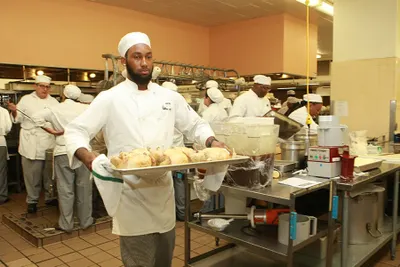
Dreams are free. LA Trade Tech makes them real.
If you need more proof that the world is on hold, drive over to the Los Angeles Trade Technical College campus in South Central Los Angeles.
[Source] The Counter
If you need more proof that the world is on hold, drive over to the Los Angeles Trade Technical College campus in South Central Los Angeles, freeway-close, as they say, to both the 10 and the 110. That big, modern building is the community college’s new culinary school, all $48 million and 71,100 square feet of it, vacant except for work crews who unload and install $76,000 ovens from Switzerland, 40- and 60-quart dough mixers, and combi-ovens that enable a student to use steam heat or dry heat or both.
The building was supposed to open at the end of this year. “Who knows when” is the revised, Covid-hobbled estimate, according to Martin Gilligan, chairman of the culinary arts program, though he hopes it will be next summer. And yet school is most definitely in session at the country’s oldest continuously operating culinary school, even though classes will be virtual at least until June.
Instead of using those top-of-the-line Swiss ovens, students complete assignments in their home kitchens, where equipment ranges from a decent oven to a toaster oven to a hotplate. They rely on ingredient boxes that contain everything they need to complete their assignments, pre-measured and packaged, distributed at a contactless delivery line in a school parking lot. There’s a lot to be discouraged by, and yet enrollment is at about half of the usual 600 students—because somebody’s going to rise out of the ashes of a devastated restaurant industry into a reconfigured normal, and these students figure it may as well be them.
For there could be a slim silver lining in a business pounded, repeatedly, by the pandemic: Students who haven’t had access to the upper echelons of chefdom before now, at a school that lacked the cachet of the big-name brands, think they see opportunity in the ruins. They tend to dream more of a small business than of empire. Right now, that may be a better fit.
LATTC’s virtual culinary school lacks what some would say is the defining element of a cook’s education: The instructor’s ability to taste.
“Covid has accelerated changes that were already there,” said Paul Freedman, author of Ten Restaurants That Changed America and a history professor at Yale University. “We were already seeing a movement toward casual, toward take-out and delivery, the democratization of dining out and the decline of the celebrity chef as a whole—partly because of #metoo, partly because people have limited tolerance for the tattooed, loudmouth celebrity chef, which even revered figures like Anthony Bourdain, as opposed to jerks like Mario Batali, have to take some responsibility for.”
There were problems with the basic business model, as well. “The mathematical model was already broken before all this happened,” said Richard Coraine, who 25 years ago co-founded Union Square Hospitality Group with Danny Meyer and is now senior adviser to the group. “You have to go through two tollbooths to open a restaurant—rent and overhead is one, and labor is the other—and the price of both of them kept going up. When revenue dips and those costs don’t dip with it? That’s what happened during Covid, which accentuated an existing problem.”
“The paradigm,” he said, “has shifted.”
The current landscape is littered with dead full-service restaurants abandoned in favor of any option that doesn’t involve real estate, walls and a roof; any idea that’s lighter on its feet, from meal kits to contactless pop-ups to places that survive as a new hybrid: the outdoor restaurant and market. Small is good, after years of the bigger the better, and LATTC students stand closer to the entry point of the new dining universe than last year’s celebrity chef does. So they show up for class, even though that means logging in from home.
“Where they’re at is, ‘Let’s keep going, even though my education isn’t hands-on, this is my career path,’” said Robert Wemischner, a chef-instructor at LATTC for 29 years. “‘I’ve made a decision. I want to proceed in a timely fashion. I’m not stopping.’ It hasn’t deterred them.”
Wemischner’s professional baking class convenes, if you can call it that, at eight in the morning, four days a week, on Zoom, though only five of his 17 students activate their video and college privacy protocols mean he can’t insist that the others do. Undaunted, he launches into the lesson on choux pastry, the base for eclairs and profiteroles, a challenge even with good equipment because it involves carefully calibrated temperatures, a “falling oven” that starts hot to get the pastry to rise, and then cools down to cook it through. In the new building, there will be banks of programmable ovens that shift automatically from one temperature to another at a pre-set time. For now, Wemischner suggests that students split the difference, settle for 375 degrees throughout, and hope for the best.
“It’ll work,” he said, “but be sure to cook them through, because if the center’s still wet, they’ll collapse. And check to make sure they don’t brown too much. Know your oven and its hot spots, maybe rotate the pans but not immediately, let the puffs rise before you move them. Turbulence might collapse them.” To prevent the bottoms of the pastries from browning too quickly, students can try setting one pan inside another, for insulation.
Each class is a balancing act between inspiration and lowered expectations, but Wemischner doesn’t dwell. He marches briskly through the next steps: how to get the dough into a pastry bag, what type of tip to use, how to pipe the dough onto parchment paper on top of a template that defined the shape, and how to get everything—dough, parchment, template—to hold still. He gives the class tips on the other components of eclairs and profiteroles, the chocolate glaze, fondant icing, ganache, and caramel icing.
In a week, students would upload photos of their efforts, alongside this week’s photos of baklava and strudel. And that would be that. LATTC’s virtual culinary school lacks what some would say is the defining element of a cook’s education: The instructor’s ability to taste. Wemischner can judge texture, appearance, even plating, but he’ll never know if a student used too much salt or overworked the dough and turned out a tough pie crust.
“There was a fear of tasting things that aren’t regulated,” said Wemischner, who teaches restaurant management as well. “We do not eat food that we cannot see being prepared. They show me pictures and maybe a comment, ‘My daughter, son, husband, wife reacted very well to this,’ and I’m asking them to be as specific as possible. I go through the albums to look at every phase to make sure they understand what I’m after. I can see what I’m looking for in a photo. But I can’t tell if they put too much salt in it. I can’t make splitting-hair distinctions.”
“It’s the next best thing,” said Wemischner, which pretty much sums up the entire school year.
Eric Campbell, one of Wemischner’s restaurant management students, started selling barbecue over 20 years ago to pay for college. He did it again when the church he attended hosted barbecues to raise funds. But it was always a sidelight because he didn’t know how to take the next step, didn’t see how to quit his healthcare day job to make a living making food.
So he enrolled at LATTC, at age 40, “because there were still things I didn’t know. Opportunities would come to me and somebody would ask where I went to school. You run into that enough, you ask: How can I jump this hurdle? So, I decided to go to school to acquire the knowledge I didn’t have.
Campbell is the student we remember from childhood, the one who always has his hand in the air and always knows the answer. He attends class seated in front of an oversized logo for his catering business, Barbara Genes’ Soul Food, named for his grandmother, who taught him how to cook. He’s one of the volunteers who work the ingredient handout in the school parking lot, showing up at 7 a.m. to help the instructors measure and pack up ingredients. His family has had to get used to his pace at home, he said, “because I might commandeer the kitchen for a whole day, make bagels, English muffins, everything in one day. I’m cranking out assignments, and then my family gets the kitchen back.”
“My entire dream is to own a food company that will embody a few different streams,” he said. “A catering stream. Products—I already have my own line of spices and sauces, a BBQ rub and sauce that are diabetic- and heart-friendly, low sugar and low sodium. A storefront, pick-up only, no dining, and a food trailer. Four streams.” Campbell has started writing his business plan and hopes to raise enough money through a combination of pop-up jobs, catering, personal savings and investors, even as he debates whether the storefront or the trailer ought to be his next move.
And he’s turned a basic culinary lesson into a life philosophy. Campbell had never heard of mise en place before he got to LATTC, though it’s a fundamental part of a professional kitchen: “everything in place” before the cooking begins. “I’ve applied that belief to every part of my life now, I’m not exaggerating,” said Campbell. “I step back and say, What do I need to do to perform this task successfully, and then I move forward. What’s the quickest, most efficient way I can bag up 20 bags of flour? Or do the laundry?” Or develop his new business.
“I might commandeer the kitchen for a whole day, make bagels, English muffins, everything in one day. I’m cranking out assignments, and then my family gets the kitchen back.”
Younger students with less experience have proportionally smaller aspirations, at least for now. Yamilet Perez, 23, defines success as a cook’s job once the pandemic is under control. She used to work 30 hours a week as a cashier and barista at a café across the street from LATTC, but her hours dipped to half that with the pandemic, and while she’s back up to 25 hours, the threat of another cutback looms. Perez is in a hurry to finish her associate’s degree this spring so she can improve her odds of getting her first kitchen job.

“It’s a tricky time,” she said. “A lot of it is that the restaurant business has taken a big hit, and that’s very scary, but also, I don’t have experience and don’t have a degree. I’ve been applying for prep cook and line cook jobs, living with my mom and my sister, and if I have to stay there until I’m stable enough to move out my mom’s happy for me to do that.” Short-term, she wants to cook at a Latin restaurant, preferably Mexican; she can’t think about running her own place until she gets some kitchen experience, but the idea is there, in the back of her head, for later.
Allec Cortez, a 24-year-old aspiring bread baker, envisions a similar timeline. He wants to start with a job baking bread, “at a mom-and-pop bakery that’d give me individualized attention, where somebody would have time to teach me more, to help me grow,” while he saves enough money to go back to school for a restaurant management degree. Owning a small bakery “feels like the most stable option, because I’d be in control, my job would not be too much at risk,” but he is in no rush. “Maybe 37 or 38 I’d be just about ready,” he said. Until then, he’d be happy to have a paycheck and ascending responsibilities.
He relies on LATTC’s network of industry connections to help him take the next step. His job, in turn, is to be the best candidate.

“I always want to prove myself in class,” he said. “I’m always on my best behavior. It’s like I’m on a perpetual job interview.”
Their plans distinguish them from the pre-pandemic aspiring chef who was always in a hurry; line cooks and sous chefs in New York City restaurants worried that if they didn’t have a restaurant by the time they were 30 they never would, a notion reinforced by various industry awards that prized youth. Opening that first place set the meter running again, because multiple outlets were a hedge against disappointing sales at a single location. No more. Racing to open, and then to turn one place into a network, feels rash; small businesses that once seemed vulnerable now look like a more reasonable response to uncertainty.
This is evolution, not revolution, likelier to stick than if it were purely pandemic fallout. “Fifteen years ago, chefs said, ‘I can’t have my dream in Manhattan anymore, it’s too expensive, so I’ll go to Brooklyn,’” said USHG’s Coraine. “Then Brooklyn became the new Manhattan, so you saw a proliferation of things. People put their business on four wheels and drove it around, but it was a slippery slope with permits, parking, and outfitting the truck, not as expensive as a restaurant but hardly free. The next step was quick-service restaurants. Then the rise of the artisan portfolio or marketplace, the ‘I’m really good at making charcuterie, or donuts, or ice cream, and I’m just going to make that.’”
Paul Freedman anticipates a greater variety of job options, and continued shrinkage at the top. “There’s been a break-up of the orthodoxy and celebrity that prevailed until the pandemic, and lots of existing restaurateurs are going to be swept away,” he said. “Old people will be the last to go back to fine dining, because of health concerns, and they’re its primary support. Young people may not be interested in it because they’ve discovered you can live without restaurants. I don’t say that with any pleasure, but I think it’s true. There will be new entries, but fewer sit-down restaurants, fewer fine dining places. There will be opportunities for various kinds of hybrids and innovations. That’s the silver lining to all this.”
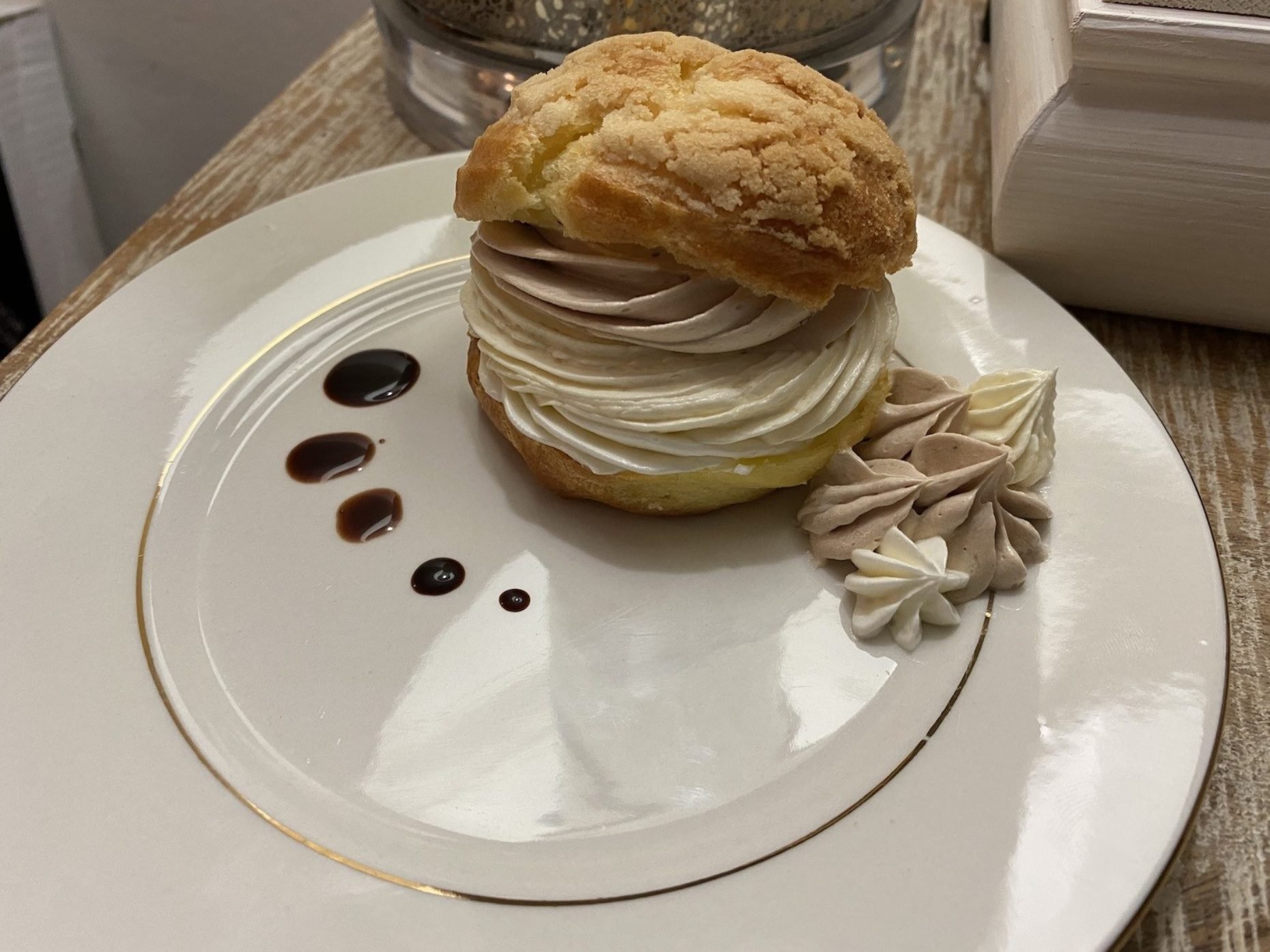
Roslyn Spence has taught both culinary and baking classes at LATTC for 20 years, following in the footsteps of her 96-year-old mother, who for years was a private chef for Mohammed Ali and Bill Cosby. She sees “excitement out the roof in class, the sense that there’s plenty of opportunity out there.”
Until now, LATTC students rarely had the chance to break through, consigned to supporting roles in the kitchen by a perfect storm of obstacles. For starters, there’s basic math: the population of a professional kitchen exists in inverse proportion to its visibility. Chefs represent a sliver of the whole, presiding over kitchens that might have dozens of cooks, and their domain, fine dining, represents in turn its own microscopic slice of the restaurant pie. That segment has flatlined at about 1 percent of total restaurant traffic for several years; you have to squint to see the space between it and nothing, even as it draws a disproportionate share of attention.
This is evolution, not revolution, likelier to stick than if it were purely pandemic fallout.
The rise of the celebrity chef made things even tighter, about ten years ago, as ambitious culinary students stampeded toward big-name, high-end schools, fueled by the notion that chefs could get rich on a mix of talent and television exposure and social media. A 10 percent increase in annual enrollment doubled, and The Culinary Institute of America, Johnson & Wales, the Institute of Culinary Education, The French Culinary Institute (now ICC) and a network of schools that licensed the Cordon Bleu name were suddenly the most popular game in town.
Before too long, though, the process of becoming a restaurant chef started to feel uncomfortably like a Ponzi scheme: There simply wasn’t enough room at the top for everyone who wanted to get there. CIA, the most resilient of the marquee schools, made what now looks like the wise move, and diversified its curriculum with classes like food photography and bachelor’s degree programs in hospitality management, applied food studies, and culinary science. Less adaptable schools folded, shrunk, or merged, one by one: Last summer, ICE merged with ICC, and Johnson & Wales announced that it was closing two of its four campuses and shifting its focus from hospitality to academics. Le Cordon Bleu, the target of several class-action lawsuits charging misrepresentation of job opportunities and potential salaries, closed all 16 of its schools in 2015.
Too many candidates for too few top jobs—and quantifiable discrimination about who got the call when a position opened up. The Bureau of Labor Statistics breaks down employment figures by gender, race and Latino ethnicity, and its most recent figures, from 2019, reflect a chronic imbalance in the professional kitchen. Of 474,000 chefs and head cooks, 63 percent were white and 78 percent were men; only 14.3 percent were Black, and 22 percent were women. “Cooks” is a far larger category—2,031,000, but white employees dominate there, too, at 70.4 percent—the only difference being that more of them, 44 percent, are women. The world Paul Freedman described, limited by gender, color and pre-existing privilege, continues not to be very interested in diversity at any level.
LATTC was never about what Freedman calls “the escalator,” a clean upward trajectory from an exclusive culinary school to a high-level, high-profile future. It is, instead, the Energizer Bunny of culinary schools, preparing generations of students for the vast mid-section of food-service jobs, providing a skill set and helping them secure employment.
Its students, over the years, were what chef-instructor Susan Feigenbaum, a 30-year veteran, refers to as “worker bees,” which she means as a compliment even though it is too often their fate rather than their choice. They’ve been the ones who work the line in a corporate dining room or a hotel, who execute the dishes a restaurant’s executive chef created, who get the work done but don’t move as far up the ladder as other candidates do.
Until now, LATTC students rarely had the chance to break through, consigned to supporting roles in the kitchen by a perfect storm of obstacles.
And they don’t usually have the means to strike out on their own, unlike some young culinary school graduates, pre-pandemic, who raised funds from friends and family to open their own restaurants. LATTC’s students come primarily from the school’s South Central Los Angeles neighborhood, a low-income area long before Covid started costing people their jobs. Over 75 percent of students receive financial aid; over 26 percent of area residents are under the poverty line, more than double the figures for California and the United States. LATTC, which is accredited by The American Culinary Association, paid for the new building it can’t yet use with funds from a 2018 bond measure designed to improve the state’s 19 community colleges, and help more of its students end their dependence on social assistance programs.
“We’re dealing with a different population than other schools in terms of ethnicities, cultural differences, economics,” said Feigenbaum. “It’s not like our students can just say, ‘I’m going to sign up for a master class, $500 a class, and go buy the ingredients. They don’t have that luxury; they desperately need those ingredients.”
In fact, ingredient boxes made the difference for some students who were unsure about signing up for virtual school.“We were miniscule before we announced that we’d provide ingredient boxes,” said Gilligan, referring to enrollment figures for the virtual semester that began in August. “I was going to have to cancel some of the classes.” One of the casualties was Feigenbaum’s class on soups and sauces—which was off the roster until a surge in applications filled it up again, by which time she’d switched to a breakfast class instead.

A comprehensive education in all aspects of food service is still the foundation of LATTC’s curriculum, even if it means that tomorrow’s cooks would learn to mop floors if only they could go indoors.“These are not prima donnas,” said Gilligan, of the way things usually work. “As soon as you come in the door, you’re feeding the public,” which used to mean staffing a cafeteria that served 400 meals a day, a full-service dining room that seats 60, a coffee bar and a coffee cart with food and snacks, as well as running a catering service. On-the-job training was an essential part of the program, and will be again, with expanded hours and seating, once the new facility opens.
“You can’t teach that pressure,” he said. “You have to put them in the environment and let them experience it. It’s why people hire people from LATTC. They’ve taken a class in stewardship, washing floors, washing dishes. They come out as ServSafe certified food managers, a step up from food handler, and there has to be a manager on every shift, so that helps them get hired.”
But hiring is up for grabs, nine months into the pandemic. At its peak in June, 2019, the restaurant industry in the Los Angeles metropolitan area employed over 401,800 people. By September 2020, that number was down to 294,800, wiping out most of the growth of the last ten years; nationwide, the restaurant sector suffered one-fourth of all Covid-related job losses, the largest number of any sector of the economy. There was an uptick in restaurant hirings that month, but with the current spike and stay-at-home orders, workers stand at the precipice and wonder if they’re going to be pushed off the cliff yet again.
LATTC has been the Energizer Bunny of culinary schools, preparing generations of students for the vast mid-section of food-service jobs, providing a skill set and helping them secure employment.
About 110,000 restaurants have closed permanently or long-term, and we haven’t yet seen the full impact of rampant new cases and winter.
Hardly a welcoming landscape: lack of access because of institutionalized discrimination, lack of financial resources to underwrite an alternative path, all of it compounded by rampant unemployment, which throws previously-employed and more experienced cooks back into the job pool to compete for fewer positions.And yet, LATTC faculty and administrators see a changed attitude among many of their students—an entrepreneurial spirit, a sense that an unsettled world might be ready for new options that promise more stability and better earnings, down the line, than the traditional mid-level food-service gig.
Nationwide, the restaurant sector suffered one-fourth of all Covid-related job losses, the largest number of any sector of the economy.
The old order has been fractured not only by the pandemic but by #metoo and Black Lives Matter, which shine a harsh light on who gets to feed us, from restaurant owners to chefs and cooks, to farmers and media personalities on cooking shows. There are cracks in the façade, and students like Eric Campbell intend to shoulder their way into those new spaces rather than settle for a job working on someone else’s dream.
He talks about having a new confidence, which translates into a desire to imprint his ideas onto status quo dishes. Feigenbaum teaches her class how to make eggs Benedict, a classic breakfast dish consisting of a split English muffin, each half topped with Canadian bacon, a poached egg, and hollandaise sauce. But Campbell balked: He’s never liked hollandaise sauce because he doesn’t like Tabasco sauce, and his catering experience has taught him that his Black customers tend not to like runny eggs.
His version, which he dubbed Soul Benedict, used adobo sauce instead of Tabasco, cheese grits instead of an English muffin, and fresh salmon broken down and made into crunchy croquettes, “so you’re still going to have to deal with this runny egg,” he said, “but look at all these other things that make the dish terrific.”
“I can ‘see’ a recipe,” he said, “the blueprint, the flavor the author is going for, and then I can hear another melody.”
Roslyn Spence went to Le Cordon Bleu in Paris 30 years ago, and recalls taking offense when a white classmate assumed that Spence would be responsible for soul food at a student potluck. Her students, in contrast, are eager to stake their culinary identities, and she thinks the time is right. “The pandemic has brought a sense of what’s really important,” she said. “There’s finally some of ‘What I cook matters,’ both me, as a Black woman, and anyone, wherever they come from. There’s so much value being put on anyone’s culture of cooking, when for many years we’ve justified what cuisine should look like based on the people who are moving way up in the industry, rather than the rest of us.”
“There’s so much value being put on anyone’s culture of cooking, when for many years we’ve justified what cuisine should look like based on the people who are moving way up in the industry, rather than the rest of us.”
“And the beauty of it is that we’re still teaching technique, but now you apply that technique to the food you’re already cooking,” she said. “Something about that just shines so brightly.”
“Adversity is the mother of invention,” said Gilligan, in a short ode to understatement. He figures that 65 percent of LATTC students “are just happy to have a good-paying job when they get out,” but it’s his job to provide a “hand-up” experience no matter what plans a student might have. That means staying away from the pie-in-the-sky promises that he feels contributed to the demise of some better-known schools.
“One reason places closed? They said you’re going to be the next Food Network star, the next chef at the Peninsula Hotel in Beverly Hills, all you have to do is pay for college,” he said, “and then they graduate and find out they’re going to make $15 an hour for the first eight years.”
Gilligan preaches the SMART plan instead—a set of goals that are Strategic, Measurable, Achievable, Realistic and Timely. Students write theirs down, present them to the class, and move forward with a dose of humility about how they’re going to achieve those goals.
“You have to go through a mental mindshift,” said Gilligan, of students’ need to right-size their dreams. “I’m not looking at how much money I’m going to make, I’m going to serve you. The ones who are successful have that mindset to begin with, and then, maybe, people throw money at them.”
Instructors this year are often as hamstrung as their students. Feigenbaum’s breakfast class early one morning was all about batter, from French toast to the Monte Cristo sandwich, turkey, ham and two cheeses, the whole thing soaked in leftover French toast batter and deep-fried—or not, because she didn’t have a deep fryer at home. She tried to make it work on a griddle until she ran into what she called “technical difficulties” with the demonstration video. A sandwich on the griddle suddenly morphed into a new sandwich in a pan; the first one “was bleeding cheese and melting out,” said Feigenbaum, and she didn’t want the students to think the end product was acceptable. Besides, she had lost some of the footage when she was editing.
“We work with what we have,” she said.
“My final breakfast class used to be, make three or four dishes in a two-minute window, but you can’t do that and make a video with a tripod in your hand.”
What she misses more, and worries about more, is the absence of hustle, the real-world kitchen experience that should have begun on the first day of school. “What we’re learning here is fine and dandy, but you have to think of the mindset at work, where we’re not making one or two sandwiches but 12 in a very short window,” said Feigenbaum. “My final breakfast class used to be, make three or four dishes in a two-minute window, but you can’t do that and make a video with a tripod in your hand. And the question needs to be, how do we make this dish feed not one or two people but 100 people? If you’re working a catering job or a food truck that’s what you need, and that’s what we don’t see now.”
“Every day we hear about another famous restaurant closing, they’re not surviving in this reality, so think of the new mentality,” she said, which she believes will have more to do with volume than with exclusivity. “If I have to do that Monte Cristo sandwich 100 times, that’s a lot of work.”
Like Wemischner, she struggles to evaluate assignments she can’t taste. “How do you judge? You hope for the best,” said Feigenbaum. “It’s hard to critically evaluate an English muffin, and the eggs look good, they’re easier to critique than a cake which might have not enough sugar, too much salt, but at least a poached egg might look really good. If they say, ‘Wow, the whole family ate this coffee cake, it’s great,’ I have to trust that.”

She has come up with a two-tiered approach, hoping simultaneously to help students who seemed most vulnerable to circumstance and reward the initiative of their more ambitious classmates. A student who didn’t complete an egg preparation might well be cooking those eggs to feed the family, Feigenbaum assumes, so she encouraged students with empty photo albums to post any kind of egg dish, to provide evidence that they are cooking at all. She can’t bring herself to be as hardline with them as she otherwise might be, but she told them that she had to see something in those albums to be able to issue a passing grade.
A student who posted dozens of photos, or skewed a dish in a creative way, got a different kind of encouragement, because those are the ones who might find an opening in the up-for-grabs world of food service. She acknowledged one student who turned out a coffee cake even though he didn’t have a stove at home. “I have to put Luis out there,” she said. “He has a little toaster oven and he bought a disposable pan that fit and made a great coffee cake, kudos to him for giving it a try.”
And she reminded everyone that the habits they develop here are going to set them up once they hit the job market, for better or worse. “Either you’re here and working, striving for the best,” she said, “or you’re out the door.”
Covid has laid waste to an industry hierarchy in a way that good intentions and diversity initiatives have not, not yet. Some places are close to immune: New York’s Le Bernardin, where the tasting menu and wine pairing goes for $395, has survived so far, in part because of almost $500,000 from a GoFundMe campaign and an anonymous donor, as well as an empathic landlord and the Paycheck Protection Program. But there are shuttered legends everywhere, up and down the economic scale; Los Angeles has lost Patina and Pacific Dining Car (which swears it will rise again), Beverly Soon Tofu House and Stan’s Donuts. Covid is an equal-opportunity scourge; there are lots of empty spaces to fill.

For chef casualties at the high end, reality’s a long drop, and the bottom’s hard to see when regulations constrict and expand like an accordion, based on case numbers. Freedman and Coraine agree that fine-dining places won’t come back full-force—and a smaller place is less of a correction for LATTC students with an entrepreneurial spirit than it is for chefs who have run a full-service kitchen and equate that job with success. A self-sufficient life in food can look like an opportunity or a disappointment, depending on where a cook used to stand.
Martha Sanchez has been a cake decorator for 25 years, and until 2017 owned a small cake supply store with a classroom in the back—but her husband died in 2015, and Sanchez, now 58, found it hard to run the business alone. She couldn’t bring in enough income teaching for the new owners part-time, so she inquired at an employment preparation center in Congresswoman Maxine Waters’ district, and found out that all those years of experience weren’t enough. She needed a degree to teach, so she enrolled at LATTC.
Her goal, once she graduates, is to teach at a vocational school or adult learning program. That, for Sanchez, is success. “I love decorating,” she said, “but I like more to teach, pass everything I know on to the next generation. It’s very satisfying when you make a cake, from nothing, and turn it into a masterpiece.”
“People are hip to all the possibilities, all the less governmentally-regulated things. It’s a sea change, and our students are aware of it.”
Maria Guzman, age 37, loves cake decorating as well, but she lost her bakery job right before the pandemic, has two children, and needed to find a way to turn baking into income. She started making coffee cakes and cookies in her apartment oven, “lots of different flavors,” and every Thursday she sent messages to people about orders that she delivers on the weekend.
School improves her technique; production, in turn, improves her performance at school; and all of it, she hopes, will pave the way back to a cake-decorating job, perhaps even her own small bakery someday. It’s not the trajectory that launched a generation of big names, but it is a life in food, which feels sufficient.
“Decorating is my passion,” Guzman said. “When I’m decorating cakes, my mind just flies.”
“People are hip to all the possibilities,” said Wemischner, “all the less governmentally-regulated things. It’s a sea change, and our students are aware of it. It’s in the zeitgeist, in the air, in the back of their minds. ‘Maybe I can work in someone’s existing kitchen to produce my own product’ rather than pay for a ghost kitchen and delivery service. They’re filled with ingenuity. There’s a lot more possibility these days. Cottage industries, do stuff at home—or just do it until you get caught.”
“It’s a rogue mentality, but it holds promise for people whose pockets are not deep, who need to make money to stay alive.”
“We’re at the intersection of patience and perseverance,” said Coraine. “If you can park your mind on, ‘Yes, it sucks right now but it’s going to change,’ get your skills and your plan together, there’s going to be a space for you. There’s going to be another side of this, and if you’re ready to go you’ll be ahead of the rest.”
Second Helpings
Subscribe for updates, articles, and commentary directly to your inbox.